What Happens at Expiration: Worthless, Assigned, Exercised or Closed
An option ends in one of four ways: it expires worthless, the short side is assigned, the long side is exercised, or you close it early. Work through each outcome with exact numbers on an XYZ put credit spread, then see where each one lands in your records.
What it is and why it matters
Every option contract has an expiration: a date after which the contract no longer exists. Before that date arrives, the contract can end in exactly one of four ways, and each one leaves a different trace in your records.
- It expires worthless. The option has no intrinsic value at expiration, so nobody has a reason to use it. Intrinsic value is what the option would be worth if used immediately: for a put (the right to sell at the strike), it is the amount the underlying sits below the strike, with a floor of zero. The contract simply disappears.
- The short side is assigned. Assignment means the option seller must fulfil the contract. A short put assignment normally buys shares at the strike; a short call assignment normally sells shares at the strike.
- The long side is exercised. Exercise is the holder's action — the holder uses the right the contract gives them. Exercise and assignment are two views of the same event: the holder exercises, the seller is assigned.
- You close it before expiration. You buy back what you sold, or sell what you bought, at whatever the market will pay. This is the only one of the four that you control outright.
Why care? Because the four outcomes produce different cash flows, different fees, different holding periods, and in two cases (assignment and exercise) they leave you holding or disposing of shares after the option is gone. If your records only show "the option ended," you cannot tell a 45-day win from a share purchase that is still sitting in the account at a loss.
One more term you need before the arithmetic: contract size, the number of underlying units one contract represents. Standard equity options usually use 100 shares, mini options use 10, and futures options use a broker-supplied multiplier. Every dollar figure below depends on it.
Work it out by hand
The example is a put credit spread on XYZ: two puts with the same expiration and different strikes, one sold and one bought.
The opening trade
With 45 days to expiration (DTE), you sell 1 XYZ $50 put for $1.35 and buy 1 XYZ $45 put for $0.45. Contract size is 100 shares. Fees are $0.65 per contract per side.
Credit received on the short leg: $1.35 × 100 = $135.00. Debit paid on the long leg: $0.45 × 100 = $45.00. Net premium before fees: $135.00 − $45.00 = $90.00. Opening fees: 2 contracts × $0.65 = $1.30. Net credit in the account: $90.00 − $1.30 = $88.70.
Two numbers follow from that, and both are expiration numbers:
- Breakeven at expiration: $50.00 − $0.90 = $49.10 per share. Including the $1.30 of fees ($0.013 per share) it is about $49.11.
- Maximum loss: the strikes are $5.00 apart, so the worst the spread can be worth is $5.00 × 100 = $500.00. Against the $90.00 credit and $1.30 of opening fees: $500.00 − $90.00 + $1.30 = $411.30.
The four outcomes
A — Both legs expire worthless. XYZ closes at $53.10 on expiration day. The $50 put's intrinsic value is max(0, $50.00 − $53.10) = $0. The $45 put is the same. Nothing is bought, nothing is sold, no closing fee is charged at most brokers. You keep the full $88.70, over 45 days in trade.
B — The short leg is assigned, the long leg expires worthless. XYZ closes at $47.20. The $50 put is in the money by $50.00 − $47.20 = $2.80 per share, so the holder exercises and you are assigned: you buy 100 shares at $50.00, paying $5,000.00. The $45 put is still out of the money and expires. The option result is unchanged at +$88.70 — that premium is already yours. What you now own is 100 shares with a basis of $50.00 each. Marked at $47.20 they are worth $4,720.00, an open loss of $280.00. Combined: −$280.00 + $88.70 = −$191.30, which is exactly what the breakeven predicts: ($47.20 − $49.10) × 100 = −$190.00, less $1.30 of fees. The share loss is not realized until you sell those shares.
C — Short assigned and long exercised together. XYZ closes at $43.00. Now both legs settle in the money: the $50 put is worth $7.00 and the $45 put $2.00, a $5.00 spread — the full width. You are assigned on the short put and buy 100 shares at $50.00 (−$5,000.00), and you exercise the long put to sell 100 shares at $45.00 (+$4,500.00). Net share flow: −$500.00. Add the $88.70 credit: −$411.30, the maximum loss calculated above. No shares remain.
D — Closed before expiration. On day 35, with 10 DTE left and XYZ at $51.00, the $50 put marks at $0.40 and the $45 put at $0.08, a net $0.32. Closing costs $0.32 × 100 = $32.00 plus $1.30 of closing fees. Realized result: $90.00 − $1.30 − $32.00 − $1.30 = +$55.40. That is 62% of the $88.70 maximum, taken in 78% of the available time, with the last ten days of risk handed back. A mark is a reference price, not a fill; your actual buy-back may cost more.
| Outcome | Day / XYZ price | $50 put (short) | $45 put (long) | Share flow | Option cash | Fees | Net result |
|---|---|---|---|---|---|---|---|
| Open | Day 0 / $52.00 | Sold at $1.35 | Bought at $0.45 | — | +$90.00 | −$1.30 | +$88.70 credit |
| A — Expired worthless | Day 45 / $53.10 | Worthless | Worthless | — | $0.00 | $0.00 | +$88.70 |
| B — Assigned | Day 45 / $47.20 | Assigned at $50 | Worthless | Buy 100 at $50.00 = −$5,000.00 | $0.00 | $0.00 | +$88.70 option; 100 shares held at $50.00 basis (−$280.00 at $47.20) |
| C — Assigned + exercised | Day 45 / $43.00 | Assigned at $50 | Exercised at $45 | −$5,000.00 then +$4,500.00 = −$500.00 | $0.00 | $0.00 | −$411.30 (max loss) |
| D — Closed early | Day 35 / $51.00 | Bought back at $0.40 | Sold at $0.08 | — | −$32.00 | −$1.30 | +$55.40 |
What changes the outcome
Change one input at a time and the whole picture moves.
Price at expiration
Put XYZ at $49.60 instead of $53.10. The $50 put is in the money by $0.40, so assignment is likely — but $49.60 is still above the $49.10 breakeven. Assigned, you buy 100 shares at $50.00 worth $4,960.00, a $40.00 open loss, against the $88.70 credit: +$48.70 combined. In the money does not mean losing.
Time remaining
Outcome D captured $55.40 of a possible $88.70 by giving up the last 10 days. The remaining $33.30 is the extrinsic value you paid back to exit — the part of an option's price above intrinsic value, which decays toward zero by expiration. Close at day 20 instead and the spread would cost more to buy back, so less of the credit is kept.
Implied volatility
Keep day 35 and XYZ at $51.00, but suppose implied volatility — the level of movement the market is pricing in — has risen. The $50 put now marks at $0.90 and the $45 put at $0.25, a net $0.65. Closing costs $65.00 instead of $32.00, so the result is $90.00 − $65.00 − $2.60 = +$22.40. Same price, same date, $33.00 less kept.
Strike width
Buy the $47 put at $0.85 instead of the $45 put at $0.45. Net premium drops to $0.50 × 100 = $50.00, so the credit after fees is $48.70 and breakeven rises to $49.50. But maximum loss falls to ($50 − $47) × 100 − $50.00 + $1.30 = $251.30. Less collected, less at stake.
Size and contract size
Five spreads instead of one: $450.00 credit less $6.50 of fees = $443.50, with a maximum loss of 5 × $411.30 = $2,056.50. Fees and risk scale together. Now change contract size instead: on a mini option representing 10 shares, the same $0.90 net premium is $9.00, and the $1.30 of fees eats 14% of it.
Fees
At $0 commissions, outcome A pays $90.00 rather than $88.70, and outcome D returns $58.00 rather than $55.40. Letting a position expire avoids the closing fee; closing early costs it. On a $90.00 credit, the $2.60 round trip is 2.9% of the premium.
Early assignment
American-style options can be assigned before expiration, most often when an option is deep in the money or, for short calls, around an ex-dividend date. That turns outcome B into an event you did not schedule, so check the broker statement rather than assuming expiration day is the only day assignment can happen.
Where you see it in MetisTrades
The same four outcomes appear across three screens, in the order you meet them.
Before expiration: Open Positions
Open Positions lists everything with open exposure, sorted by Expiration ascending so the nearest dated rows come first. DTE — days to the nearest expiration among open legs — can be added from Customize columns, and its styling becomes more urgent as expiration approaches and distinguishes expired positions. Extrinsic shows the estimated time value remaining, the figure that was $33.30 in outcome D. Look at how DTE and expiration shape the row order here.
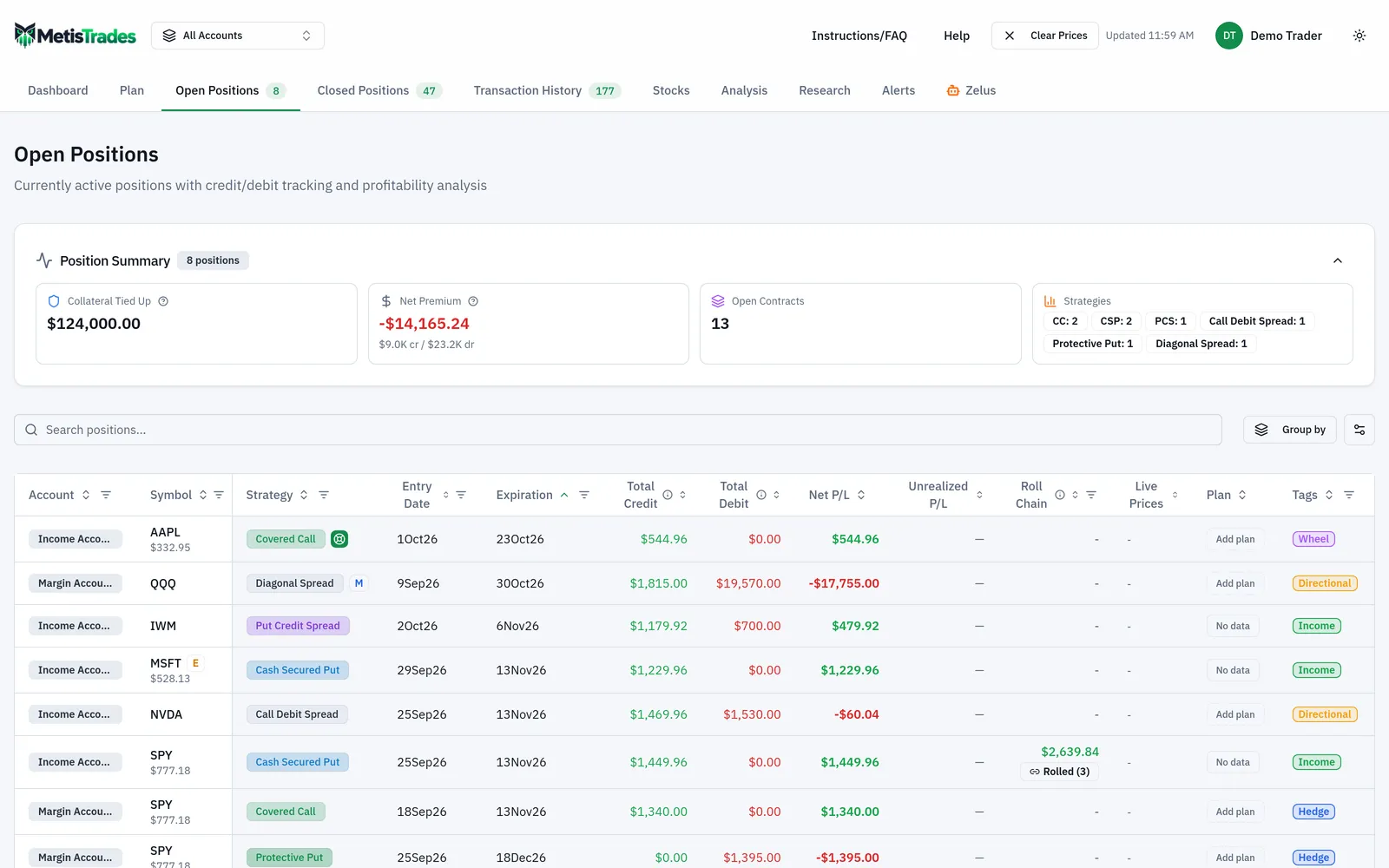
Two fields in the table map onto the hand calculation. Net P/L is transaction-derived: the $88.70 credit, before any mark is applied to still-open legs. Unrealized P/L adds the estimated cost of closing at fetched marks — the $32.00 in outcome D. Those marks come from Refresh Prices in the desktop site header, which requires you to be signed in and whose tooltip warns quotes can be delayed by up to about 15 minutes.
Recording an ending event is a deliberate act; nothing closes automatically. The amber Past due banner is informational — it counts expired contracts still shown as open. To record an outcome, click Past due on the row: that opens the regular close modal for that position's expired legs only, and live legs in the same position are not included. All expired legs start selected with Expire Worthless as the default outcome, and the source material notes you should check the outcome against your broker statement before saving.
Outcome A is that default. Outcome B is a case where the legs differ, so uncheck the leg that did not share the chosen outcome, record Assigned for the short $50 put, then reopen Past due on the refreshed row and expire the $45 put worthless. Outcome C, where the broker statement confirms both sides really settled in the money, uses Assigned + Exercised to assign selected shorts and exercise selected longs together; the app does not infer outcomes from moneyness. Outcome D is different in kind — on day 35 nothing has expired, so you use the row's close action, which opens the close modal for all open legs including legs that have not expired.
After expiration: Closed Positions
A position belongs on Closed Positions once it has no open exposure, and closing trades, expiration, assignment or exercise can all supply that ending event. The table opens sorted by Exit Date descending. Note which columns carry the arithmetic above: Total Credit and Total Debit, Realized P/L, Days in Trade (DIT) (45 days for outcomes A to C, 35 for D), and Result, which reads Win when realized P/L is zero or positive.
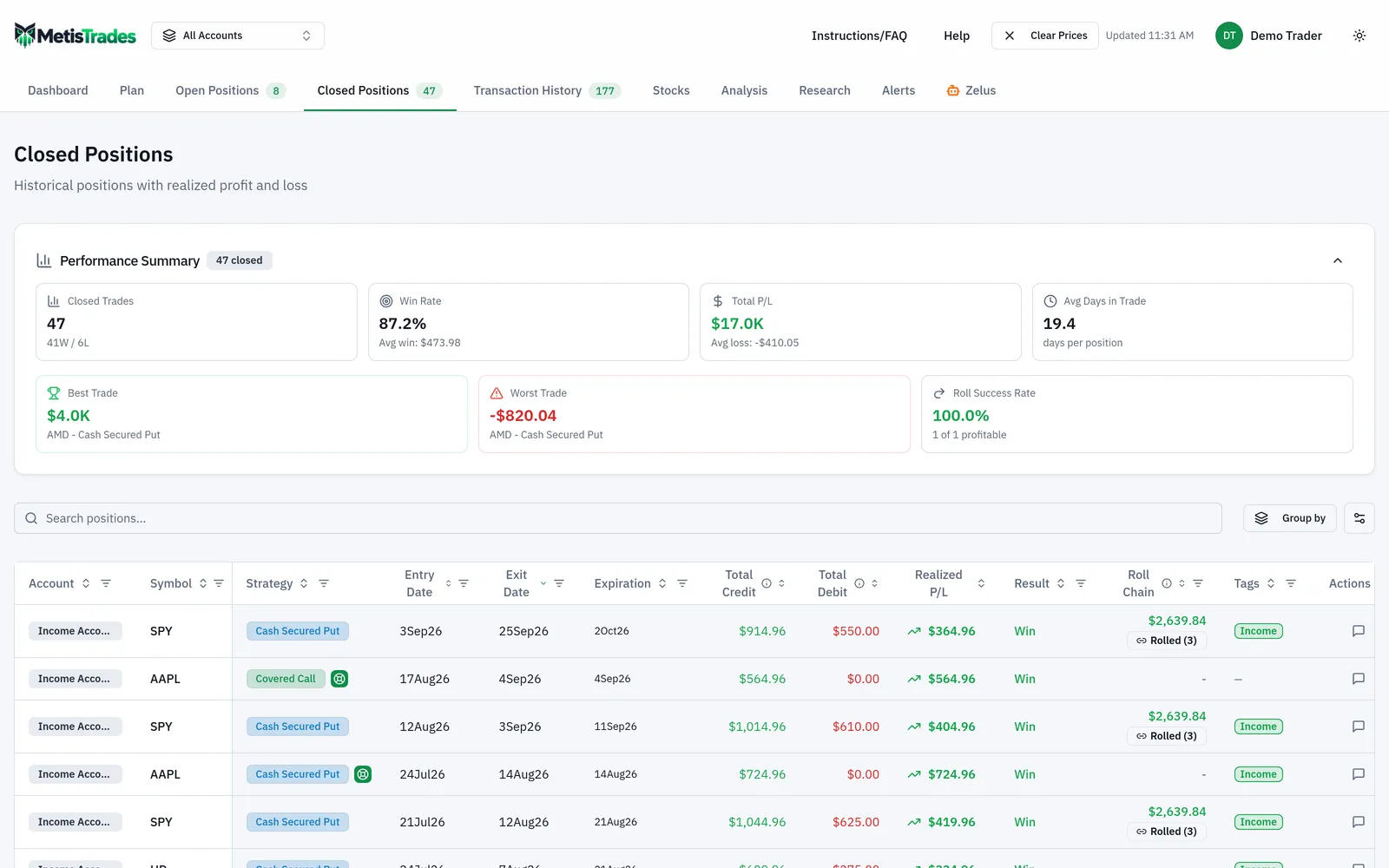
The performance summary above the table rolls those rows into Closed Trades, Win Rate, Total P/L, Avg Days in Trade and, when available, Best Trade and Worst Trade. Read win rate alongside total P/L: outcomes A and D are both wins, while the single outcome C loss of $411.30 is larger than either. One caution carried over from the hand calculation: partial quantities can leave remaining exposure open, so closing part of a position does not necessarily move the whole strategy here.
When shares change hands: Analysis → Assign/Exercise
Outcomes B and C also produce share events, and the Assign/Exercise page (/analysis/assignments, available to Pro users and admins) gathers them by symbol. Look at how the option premium sits beside the share result rather than being merged into it.
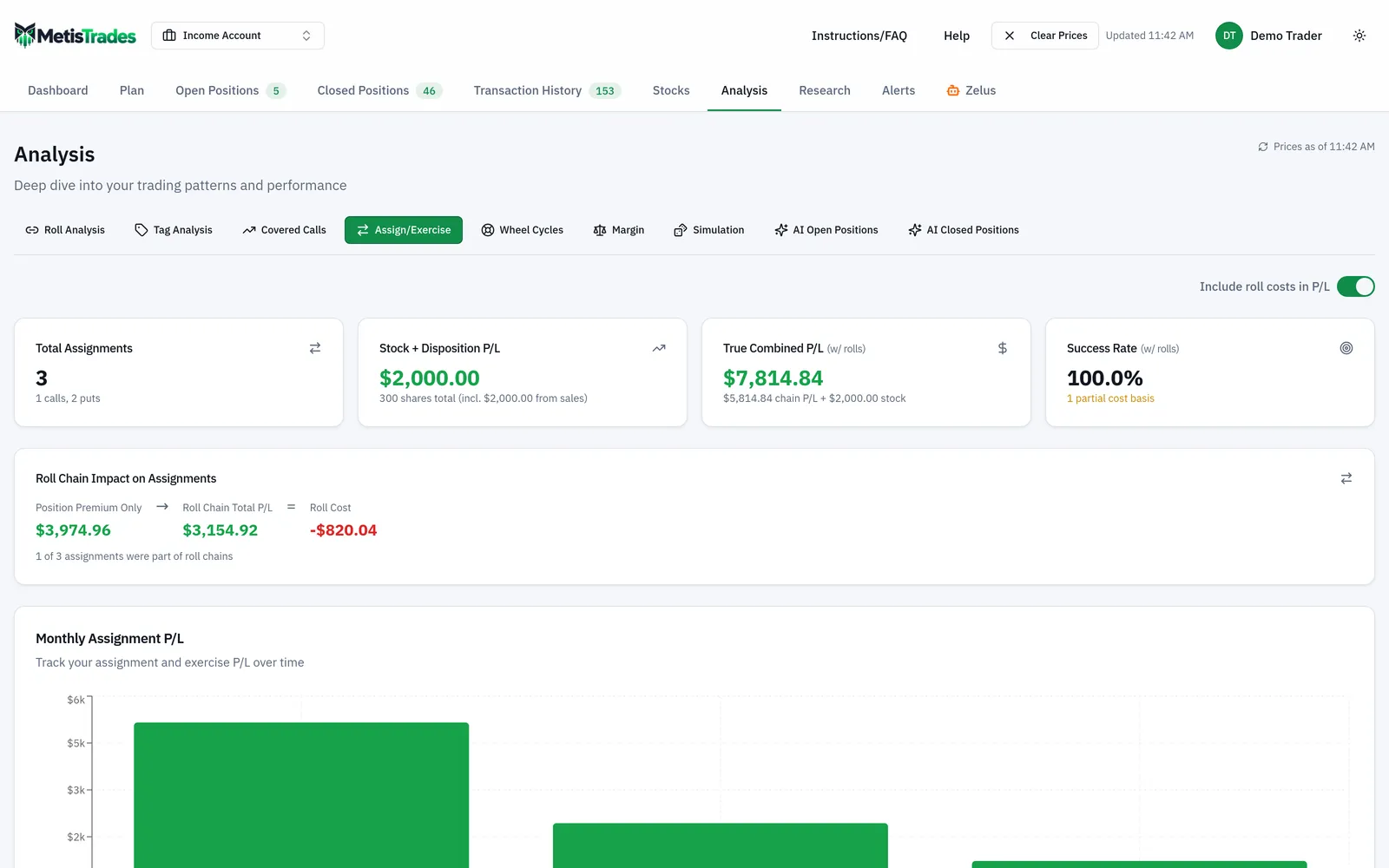
The summary cards show Total Assignments with call and put counts, Net Stock P/L, Combined P/L and Success Rate. The Assignment Details by Symbol table carries Symbol, Assignments, Avg Strike, Avg Cost Basis, Avg Gain/Share, Premium, Stock P/L and the combined result; expanding a symbol opens its history with Call Assigned, Put Assigned and Exercised badges.
For a put-side event like outcome B, the page records the strike as the acquired-share basis — $50.00 — and the immediate stock P/L is zero, with the option premium tracked separately. That matches the hand calculation: the $280.00 is an open mark-to-market figure on shares you still hold, not a realized result. When those shares are later sold, the page estimates Disposition P/L, and the combined figure becomes True Combined P/L. A Partial badge means basis was available for only some of the shares, in which case stock P/L covers only those shares. For a call-side sale, stock P/L is strike minus FIFO cost per share, multiplied by the shares with known basis. All of it is estimated from imported transactions.
Common mistakes
- Treating "in the money" as "losing". At $49.60 the $50 put is in the money and the spread is still ahead by $48.70. Fix: compare the closing price with your breakeven ($49.10), not with the strike.
- Expecting expired positions to clear themselves. The Past due banner counts expired contracts still shown as open and explains they are not closed automatically. Fix: open Past due on the row and record the outcome your broker statement confirms.
- Recording both legs with the same outcome. In outcome B the short was assigned and the long expired worthless. Fix: uncheck the legs that did not share the chosen outcome, save, then reopen Past due for the rest.
- Using Past due for an early exit. The Past due flow covers expired legs only and leaves live legs out. Fix: for a day-35 buy-back like outcome D, use the row's close action, which opens the close modal for all open legs.
- Thinking assignment realizes the loss. After outcome B you hold 100 shares at a $50.00 basis and nothing is settled until you sell them. Fix: read the option result and the later Disposition P/L as two separate steps.
- Assuming every contract is 100 shares. Mini options use 10 and futures options use a broker-supplied multiplier. Fix: confirm the multiplier before multiplying premium or share counts.
- Reading a mark as a fill. The $0.32 close is a reference value from quotes delayed by up to about 15 minutes, and a wide bid-ask spread can cost more. Fix: treat Unrealized P/L as an estimate and check the actual fill against it.
Related guides and help pages
Related guides
- Plan, Track, Optimize: a complete tour of MetisTrades
- Premium, Credits and Debits: How Option P/L Is Counted
- Assignment and Exercise Explained: Shares, Cash and Basis
- Tracking the Wheel Strategy: Premium, Share Basis and the Cycle Result
- Tracking assignments and exercises: shares, basis and what happened next
- Keeping Track of Open Positions: Legs, Days to Expiry and Mark-to-Market P/L