Assignment and Exercise Explained: Shares, Cash and Basis
Assignment and exercise are how an option turns into stock. Learn what moves, when it can happen, what your share basis becomes, and how MetisTrades records each event.
What it is and why it matters
An option contract is an agreement between two people. One side holds the right; the other side carries the obligation. Exercise is the holder using that right. Assignment is the obligation landing on a seller. They are two names for the same event seen from opposite ends of the contract.
Three terms do most of the work here:
- Call — gives the holder the right to buy the underlying at the strike. The seller of a call may be required to deliver shares.
- Put — gives the holder the right to sell the underlying at the strike. The seller of a put may be required to buy shares.
- Strike — the fixed price at which that buying or selling happens, regardless of where the stock is trading at the time.
So if you are short a put and it is assigned, you buy shares at the strike. If you are short a call and it is assigned, your shares are sold at the strike. If you are long an option and you exercise it, the same transaction occurs with you on the other side. Contract size decides how many shares move: standard equity options usually represent 100 shares, mini options 10, and futures options use a broker-supplied multiplier, so never assume 100 without checking.
Early assignment versus expiration
Most assignments happen at expiration. If a short option finishes in the money — a call with the stock above the strike, or a put with the stock below it — it is likely to be exercised by whoever holds it, and the shares move over the weekend. You find out after the fact.
Early assignment happens before expiration. American-style equity options can be exercised by the holder on any business day, so a short option can be assigned at any time while it is open. In practice it clusters around two situations: a short call that is deep in the money just before an ex-dividend date, where the call holder wants the shares in time to collect the dividend; and a short put that is deep in the money with almost no extrinsic value left, where the holder gains nothing by waiting. You cannot control it and you do not get a warning.
Why it matters for your records
Assignment is the moment an options trade becomes a stock position, or stops being one. Two things change at once: your share count and your cash. A third thing is created quietly — the cost basis of any shares you acquired, which is the figure a later sale is measured against. Traders who only track option premium lose sight of all three, then cannot explain why the account balance moved or what the shares actually cost them. Options carry real risk of loss, and an assignment is often where that loss or gain is made concrete, so the record needs to be right.
Work it out by hand
Here is one underlying, XYZ, over three events. You sell two cash-secured puts, get assigned, then write covered calls against the 200 shares and get assigned twice more. Every figure below can be produced with a calculator.
The companion spreadsheet holds the same three rows and the formulas that compute the marked columns, so you can change a strike or a premium and watch the result move.
Download the template: Assignment and exercise log (.xlsx). It opens in Excel, and in Google Sheets via File → Import. The worked example from this guide is already filled in, and the formulas carry down into the blank rows.
| Date | Symbol | Option | Contracts | Strike | Premium / share | Shares +/− | Stock cash | Premium-adjusted price | Shares held after |
|---|---|---|---|---|---|---|---|---|---|
| 2026-01-16 | XYZ | Put | 2 | 50 | 1.5 | 200 | -10000 | 48.5 | 200 |
| 2026-02-20 | XYZ | Call | 1 | 54 | 1 | -100 | 5400 | 55 | 100 |
| 2026-03-20 | XYZ | Call | 1 | 52 | 1.2 | -100 | 5200 | 53.2 | 0 |
| Totals | 0 | 600 |
Step 1: the put assignment on 2026-01-16
You were short 2 puts at the 50 strike and collected 1.5 per share when you opened them. XYZ closes below 50 on expiration Friday and the puts are assigned. A short put assigned means you buy.
Shares: 2 contracts × 100 shares × (+1 because it is a put) = +200 shares.
Cash: you buy 200 shares at the 50 strike, so 200 × 50 = 10,000 leaves the account. Recorded as −10,000. Note that the price you pay is the strike, not the market price. If XYZ was trading at 47 that Friday, you still paid 50.
Premium-adjusted price: strike − premium = 50 − 1.5 = 48.50. This is a tracking figure. It says the shares effectively cost you 48.50 each once the premium you already collected is counted against them. It is not your tax basis. For tax purposes the shares were acquired at the 50 strike, and the 1.5 premium is a separate option result.
Shares held after: 0 + 200 = 200.
Step 2: the first call assignment on 2026-02-20
You sold 1 covered call at the 54 strike for 1 per share. XYZ finishes above 54 and the call is assigned. A short call assigned means you sell.
Shares: 1 × 100 × (−1 because it is a call) = −100 shares.
Cash: 100 shares × 54 = +5,400 into the account. Again at the strike, not the market price.
Premium-adjusted price: strike + premium = 54 + 1 = 55.00, what the shares effectively sold for.
Shares held after: 200 − 100 = 100.
Step 3: the second call assignment on 2026-03-20
You wrote another call, this time at the 52 strike for 1.2, and it is assigned too. Shares: −100. Cash: 100 × 52 = +5,200. Premium-adjusted price: 52 + 1.2 = 53.20. Shares held after: 100 − 100 = 0.
Step 4: the totals
Net shares = 200 − 100 − 100 = 0. The position is flat; you started with no XYZ and you end with none.
Net stock cash = −10,000 + 5,400 + 5,200 = +600. That 600 is the stock side of the whole sequence, and because every share came from the put assignment at a 50 basis you can check it the other way: the first call sold 100 shares at 54, giving (54 − 50) × 100 = 400; the second sold 100 at 52, giving (52 − 50) × 100 = 200; 400 + 200 = 600. Two routes, same answer.
The option side is kept separate, which is the point of the premium-adjusted column being a note rather than an input. Premium collected was 2 × 1.5 × 100 = 300 on the puts, 1 × 1 × 100 = 100 on the first call, and 1 × 1.2 × 100 = 120 on the second: 520 in total. Stock result 600 plus option result 520 is 1,120 across the sequence, before commissions and fees.
What changes the outcome
Change one number at a time in the worked example and see what moves.
Strike
Make the second call strike 56 instead of 54. Stock cash becomes 100 × 56 = 5,600 rather than 5,400, net stock cash rises from 600 to 800, and the premium-adjusted sale price becomes 57.00. A higher call strike sells the same shares for more. On the put side it works in reverse: a put struck at 48 rather than 50 would have cost 2 × 100 × 48 = 9,600 rather than 10,000, so your basis per share is lower and the later call-away produces a larger stock gain.
Premium
Premium never changes the cash from the share transfer. Drop the put premium from 1.5 to 0.5 and the shares still cost 10,000, net stock cash is still 600. Only the premium-adjusted price moves, from 48.50 to 49.50, and the separate option result falls from 300 to 100. This is why the two sides are tracked apart: premium cushions the trade but it does not alter what the shares cost at the strike.
Contracts and contract size
Sell 3 puts instead of 2 and the first row becomes +300 shares and −15,000 of stock cash. Everything scales linearly with contracts. Contract size scales it too: if these were mini options at 10 shares per contract, 2 puts would deliver 20 shares and cost 1,000, not 10,000. Get the multiplier wrong and every downstream figure is wrong by the same factor.
Where the stock is trading
The market price on assignment day does not appear anywhere in the arithmetic, and that is the single most useful thing to notice. If XYZ had collapsed to 40 on 2026-01-16, you would still have paid 10,000 for shares worth 8,000. The strike sets the transfer price; the market price only tells you how good or bad that transfer was.
Timing: early versus expiration
Suppose the 54 call had been assigned early, on 2026-02-05, because XYZ went ex-dividend on 2026-02-06. The shares and cash are identical — −100 shares, +5,400 — but two things change. You no longer own the shares on the ex-dividend date, so you do not receive that dividend. And your holding period for those 100 shares ends 15 days sooner, which matters for whether a gain is counted as short-term or long-term.
Partial assignment
If only 1 of the 2 puts had been assigned on 2026-01-16, you would hold 100 shares at a 10,000 ÷ 2 = 5,000 cost, with one put still open. Brokers do assign part of a multi-contract position. A log that assumes all-or-nothing will show share counts that do not match the broker's.
Fees
Assignment fees, exercise fees and any commission on the opening option trade are not in the figures above. A 5.00 assignment fee on each of the three events would take the 1,120 combined result to 1,105. Small per event, visible over a year.
Where you see it in MetisTrades
MetisTrades detects these events from your imported broker history rather than asking you to enter them. A detected event is an option leg closed by an imported assignment or exercise lifecycle record, which is then attached to the closing option leg. If the import is missing the lifecycle record or the matching stock transaction, the event may not be detected at all.
Analysis → Assign/Exercise
The page lives at Analysis → Assign/Exercise. It is available to pro users and admins; a signed-in user without an active subscription or lifetime access cannot reach the Analysis tab. At the top, summary cards report Total Assignments with call and put counts, Net Stock P/L, Combined P/L and Success Rate. Where later share sales exist, those cards become Stock + Disposition P/L and True Combined P/L.
Below the cards, Assignment Details by Symbol is the table that lines up with your hand log. Its columns are Symbol, Assignments, Avg Strike, Avg Cost Basis, Avg Gain/Share, Premium, Stock P/L, and either Combined P/L or True Combined. Expand a symbol and you get Assignment History for that symbol, one row per event, with Type, Strike, Cost Basis, Shares, Date, Premium, Stock P/L and the combined result. Look at how the type badges — Put Assigned, Call Assigned, Exercised — map onto the Option column in your sheet, and at how Cost Basis on a call row corresponds to the 50 strike that created the shares.
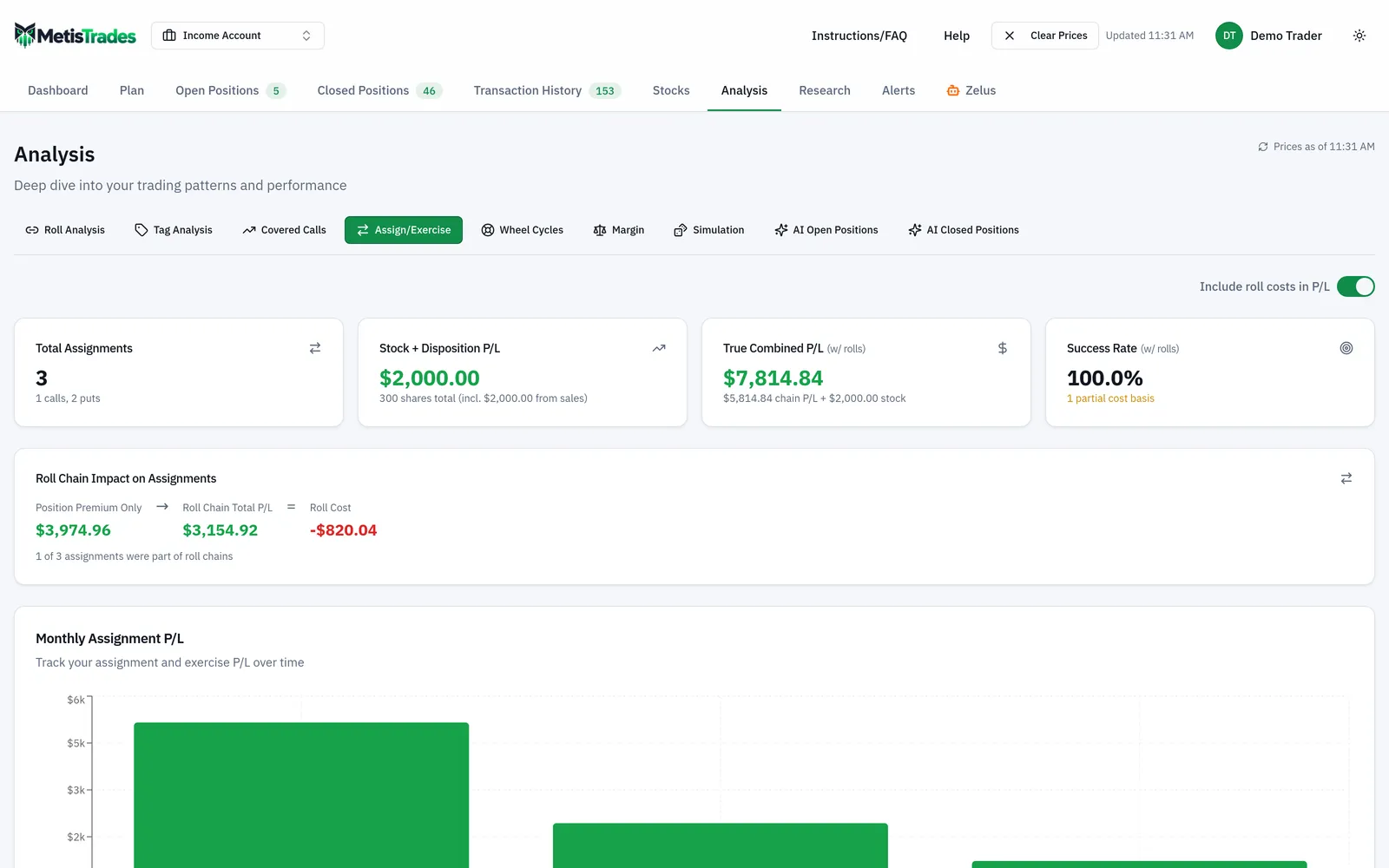
The arithmetic matches the hand method in a specific way worth knowing. For a put-side event, the strike is recorded as the acquired-share basis and immediate stock P/L is zero, with option premium kept separate — exactly the split you made in step 1. For a call-side share sale, Stock P/L is strike minus the FIFO cost per share, multiplied by the shares with known basis, which is the (54 − 50) × 100 and (52 − 50) × 100 calculation from step 4. If basis exists for only some shares, the row carries a Partial badge and the unknown shares are excluded rather than treated as profit. Disposition details show Holding with a remaining count, Sold, or the number still held after a partial sale.
Two controls change what the combined figures mean. Include roll costs in P/L appears when at least one event belongs to a roll chain and is on by default; with it on, the full roll-chain P/L replaces the final position's premium, so a put you rolled three times before assignment is counted across its whole life. The type filter (All, Assigned, Exercised) and side filter (All, Calls, Puts) drive the cards, the roll-impact card, the Monthly Assignment P/L chart, the symbol table and the expanded histories together.
Wheel Cycles
The three rows in the worked example are a complete wheel: a put assigned into shares, covered calls written against them, and the shares called away. MetisTrades starts a wheel cycle when an imported short put leg is assigned and delivers shares, and marks it completed only after all assigned shares have been disposed. Look at the Timeline to see the put, each covered call and the final disposition in order, and at Cycle Summary for put premium, call premium, stock disposition P/L and Net P/L. Capital at risk is the assigned put strike multiplied by the assigned shares — here 50 × 200 = 10,000, the same number as your stock cash on row one.
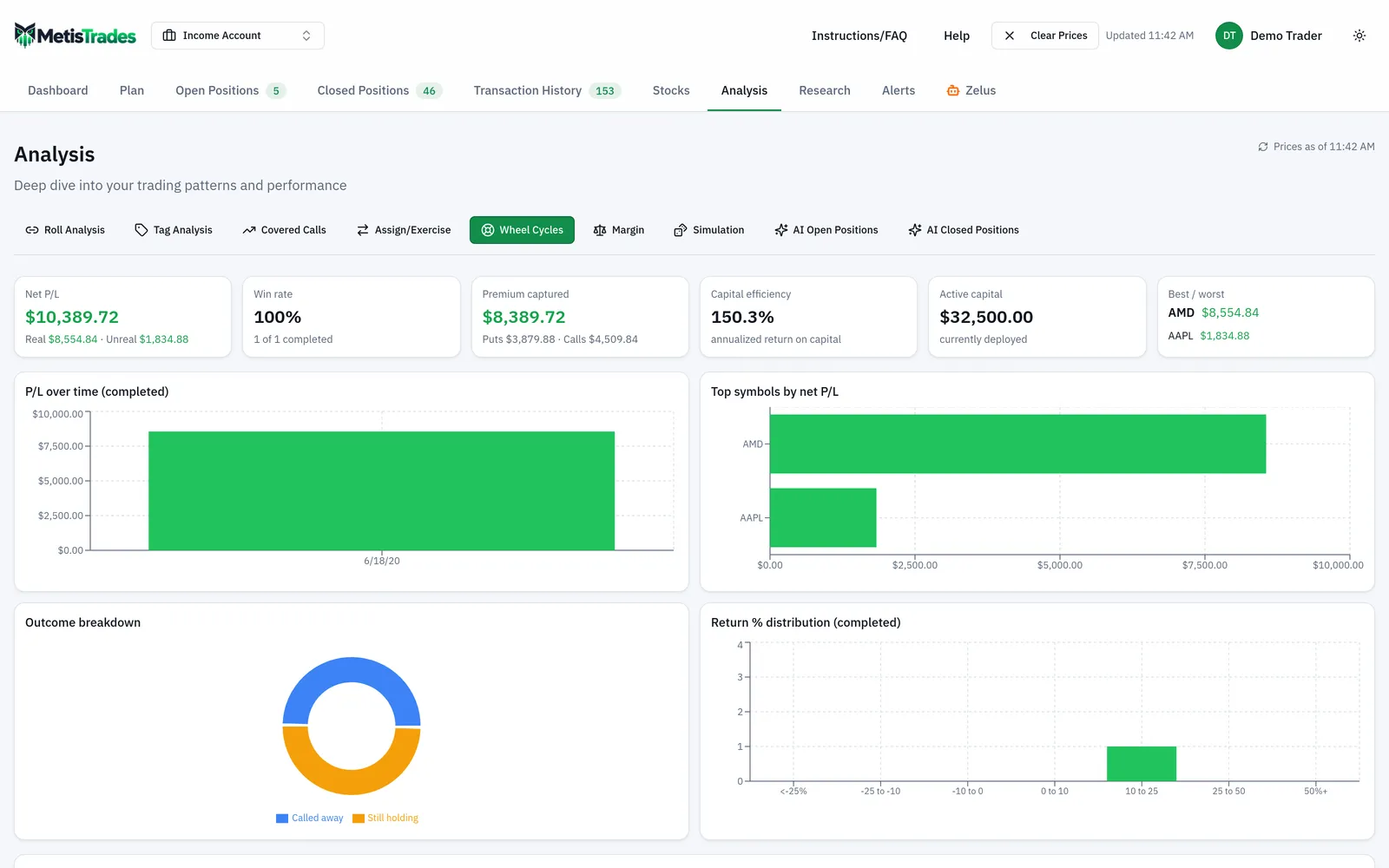
Wheel-cycle tracking is available on Pro portfolio surfaces, and you need an active subscription or lifetime access to reach the dedicated Wheel Cycles Analysis sub-tab. If the detector attaches the wrong covered call, use Attach and Detach in the Timeline to correct membership; manually added links are shown as Manually linked.
Everything on both screens is an estimate built from your imported transactions. FIFO share basis, stock matching, dispositions, roll links and all P/L figures depend on complete import history, and tax-related figures are not a substitute for your broker's 1099-B. These pages focus on imported assignment, exercise and share-disposition records, so they do not reflect delayed quote movement.
Common mistakes
- Treating the premium-adjusted price as cost basis. 48.50 is a tracking figure; the shares were acquired at the 50 strike. Keep the premium in the option column and let the basis be the strike.
- Using the market price instead of the strike for the share transfer. Assignment always transacts at the strike. Record 200 × 50 = 10,000 even if XYZ closed at 47.
- Assuming assignment only happens at expiration. Short options can be assigned early, especially calls before an ex-dividend date. Check share counts after every ex-dividend date, not just after expiration Friday.
- Assuming every contract is 100 shares. Mini options use 10 and futures options use a broker multiplier. Put the multiplier in its own column so the share and cash formulas pick it up.
- Logging all-or-nothing assignment. Brokers can assign 1 of your 2 contracts. Record the contracts actually assigned and leave the remainder open.
- Forgetting that the stock side has its own result. Premium of 520 looks fine until you see the stock side separately; here it added 600, but it can just as easily subtract. Track net stock cash alongside net premium.
- Expecting MetisTrades to detect an event with a gappy import. Detection needs the assignment or exercise lifecycle record and the matching stock transaction. If a symbol shows Partial or nothing at all, check the import for the missing stock legs.
Related guides and help pages
Related guides
- Calls and Puts: What an Option Contract Actually Is
- Premium, Credits and Debits: How Option P/L Is Counted
- Contract size and the 100-share multiplier
- The Greeks in practice: delta, theta, vega and gamma
- Implied Volatility: What Option Prices Say About Movement
- What Happens at Expiration: Worthless, Assigned, Exercised or Closed