The Greeks in practice: delta, theta, vega and gamma
Delta, theta, vega and gamma describe how an option position reacts to price, time and volatility. Work out the position Greeks of a two-leg put spread by hand, then see where those same estimates appear in MetisTrades.
What it is and why it matters
An option's price moves for a handful of reasons: the underlying stock moves, a day passes, or the market changes its mind about how much the stock might move. The Greeks are model estimates that put a number on each of those sensitivities, one at a time.
Four of them cover most of what a trader needs day to day:
- Delta — the approximate change in a position's value for a $1 move in the underlying. It is usually expressed in share-equivalents: a position delta of +50 behaves roughly like owning 50 shares.
- Theta — the approximate daily change in value from time decay alone, all else equal. Negative theta loses value as days pass; positive theta gains.
- Vega — the approximate change in value for a one-percentage-point change in implied volatility. Implied volatility (IV) is the level of future movement implied by an option's market price under a pricing model. It is not a direction forecast.
- Gamma — how fast delta itself changes for a $1 move in the underlying. Gamma is the reason your delta today is not your delta tomorrow.
A few supporting terms before the arithmetic. A leg is one stock or option part of a position; a spread has several. A contract for a standard equity option normally represents 100 shares, though mini options and futures options use other multipliers, so check before you assume 100. Quoted Greeks from a chain are normally per share for one long contract, which means you have to sign them and scale them before they tell you anything about your actual position.
Why care? Because the Greeks are what turn "I'm short two puts" into a sentence with numbers in it: how many shares of directional exposure you are carrying, how many dollars a quiet day is worth to you, and how much a volatility spike would cost. They are estimates produced by a model from available quote and contract inputs, and they change as price, time and volatility change. Options carry risk that the Greeks describe but do not reduce.
Work it out by hand
The worked example is a two-leg put spread on a stock we will call XYZ: short two of the 50-strike puts, long two of the 45-strike puts. Both legs are the same expiration. The quoted Greeks below are per share for one long contract, which is how an option chain normally presents them.
Step 1: sign the contracts
Write the quantity of each leg with a sign: + for long, − for short. The short 50 put is -2. The long 45 put is +2. Getting this wrong flips the sign of every number that follows, so do it first and do it deliberately.
Step 2: scale each Greek to the position
For each leg and each Greek:
Position figure = per-share Greek × signed contracts × 100
The 100 is the contract multiplier. Delta comes out in share-equivalents; theta comes out in dollars per day; vega comes out in dollars per volatility point.
Step 3: do the six multiplications
Short XYZ 50 put, signed contracts −2, delta/share −0.3, theta/share −0.04, vega/share 0.06:
- Position delta: −2 × −0.3 × 100 = 60. Two negatives make a positive — short puts are a bullish position, so positive delta is correct.
- Position theta: −2 × −0.04 × 100 = 8. The option you are short loses value with time, and that loss is your gain, so theta is positive: about $8 a day.
- Position vega: −2 × 0.06 × 100 = −12. You are short volatility on this leg: one point of IV added costs about $12.
Long XYZ 45 put, signed contracts +2, delta/share −0.12, theta/share −0.02, vega/share 0.04:
- Position delta: 2 × −0.12 × 100 = −24. A long put is bearish, so negative delta.
- Position theta: 2 × −0.02 × 100 = −4. You own this one, so time decay works against you: about −$4 a day.
- Position vega: 2 × 0.04 × 100 = 8. The long wing is long volatility.
Step 4: add the columns
Net delta: 60 + (−24) = 36 share-equivalents. Net theta: 8 + (−4) = 4 dollars per day. Net vega: −12 + 8 = −4 dollars per volatility point.
| Leg | Signed contracts | Delta / share | Theta / share | Vega / share | Position delta | Position theta | Position vega |
|---|---|---|---|---|---|---|---|
| Short XYZ 50 put | -2 | -0.3 | -0.04 | 0.06 | 60 | 8 | -12 |
| Long XYZ 45 put | 2 | -0.12 | -0.02 | 0.04 | -24 | -4 | 8 |
| Net | 36 | 4 | -4 |
Read those three totals as sentences. Net delta 36: the spread currently behaves roughly like owning 36 shares of XYZ, so a $1 rise is worth about $36 and a $1 fall costs about $36. Net theta $4 per day: if nothing else changes, a day passing is worth about $4 to you — the short leg decays faster than the long one. Net vega −$4 per vol point: if implied volatility rises one point with price and time unchanged, the position loses about $4; if IV falls a point, it gains about $4.
Notice how small the net vega is. The two legs largely cancel, which is typical of a defined-width spread and is the kind of thing you only see once you scale and sign each leg rather than eyeballing the short strike alone.
The spreadsheet below contains this example with the formulas already in place, so you can change the per-share Greeks or the contract counts and watch the totals move.
Download the template: Position Greeks worksheet (.xlsx). It opens in Excel, and in Google Sheets via File → Import. The worked example from this guide is already filled in, and the formulas carry down into the blank rows.
Its computed columns are the three multiplications you just did: position delta is =IF(A{r}="","",N(B{r})*N(C{r})*100), position theta is =IF(A{r}="","",N(B{r})*N(D{r})*100), and position vega is =IF(A{r}="","",N(B{r})*N(E{r})*100), with {r} standing for the row. The IF keeps blank rows blank so you can add legs without the totals breaking.
What changes the outcome
Each paragraph below changes exactly one input in the worked example so you can see which total moves.
The underlying price (and gamma)
Suppose XYZ falls and the short 50 put's delta/share moves from −0.3 to −0.45 while the long 45 put's goes from −0.12 to −0.20. Position delta on the short leg becomes −2 × −0.45 × 100 = 90, and the long leg becomes 2 × −0.20 × 100 = −40. Net delta is now 90 − 40 = 50, up from 36. You did not trade anything; the position simply became more directional as the stock moved toward the short strike. That drift is gamma. Short-strike-heavy positions pick up gamma as expiration nears, which is why yesterday's delta is a poor guide to today's exposure.
Time passing
Net theta of $4 per day does not mean $40 over ten days. It is a snapshot rate: tomorrow's theta is recalculated from tomorrow's price, time and IV. If the stock sits still and the short leg's theta/share moves from −0.04 to −0.06, the short leg contributes −2 × −0.06 × 100 = 12 and net theta becomes 12 − 4 = 8 per day. Decay accelerates near expiration for options near the money.
Implied volatility
Net vega of −4 means a one-point IV rise costs about $4. A five-point rise costs roughly 5 × $4 = $20 — and, because higher IV generally raises both legs' prices, it usually arrives alongside a change in delta and theta too. Vega also tends to shrink as expiration approaches, so the same spread held for three weeks will not carry the same volatility exposure it had on day one.
The strike you choose
Move the long wing from 45 up to 48 and its delta/share might be −0.22 instead of −0.12. Position delta on that leg becomes 2 × −0.22 × 100 = −44, so net delta drops to 60 − 44 = 16. The narrower spread is far less directional — and, because its vega offset is larger, the net vega moves closer to zero as well. Strike selection changes all four Greeks at once.
Position size
Double the trade to −4 and +4 contracts and every figure doubles: net delta 72, net theta 8, net vega −8. Greeks scale linearly with quantity, which makes them a convenient way to compare positions of different sizes in common units.
The contract multiplier
If the contract represented 10 shares rather than 100, the short leg's position delta would be −2 × −0.3 × 10 = 6, and net delta would be 6 − 2.4 = 3.6. Using 100 for a contract that is not 100 shares inflates every number by a factor of ten.
Fees
Greeks say nothing about commissions. If opening and closing this two-leg, two-contract spread costs you $2.60 in total commissions, that is roughly two-thirds of a day's net theta at $4 per day. Small on this trade; not small if you trade a lot of narrow spreads.
Where you see it in MetisTrades
The first place these numbers appear is on a position you already hold. Open an Open Positions or Closed Positions row to get Position details, the scrollable dialog that holds the legs, pricing and history. Once usable prices are available, its Position Greeks block can show Delta, BW Delta, Gamma, Theta and Vega. Position Delta there is described as combined directional exposure across priced open legs — the same idea as the 36 you calculated, expressed in share-equivalents. BW Delta is that delta adjusted by the symbol's beta and underlying price relative to SPY, so it is a different unit from your worksheet total.
Below that, Option Legs lists calls before puts with higher strikes first, and each priced open leg can carry a Greeks line. Its labels tell you exactly what each number is: Delta: Price change per $1 stock move, Gamma: Rate of Delta change, Theta: Daily time decay per contract, Vega: Price change per 1% IV move, plus implied volatility. Read the units on those labels before comparing them with your spreadsheet — theta there is stated per contract, while your worksheet column is scaled to the whole leg.
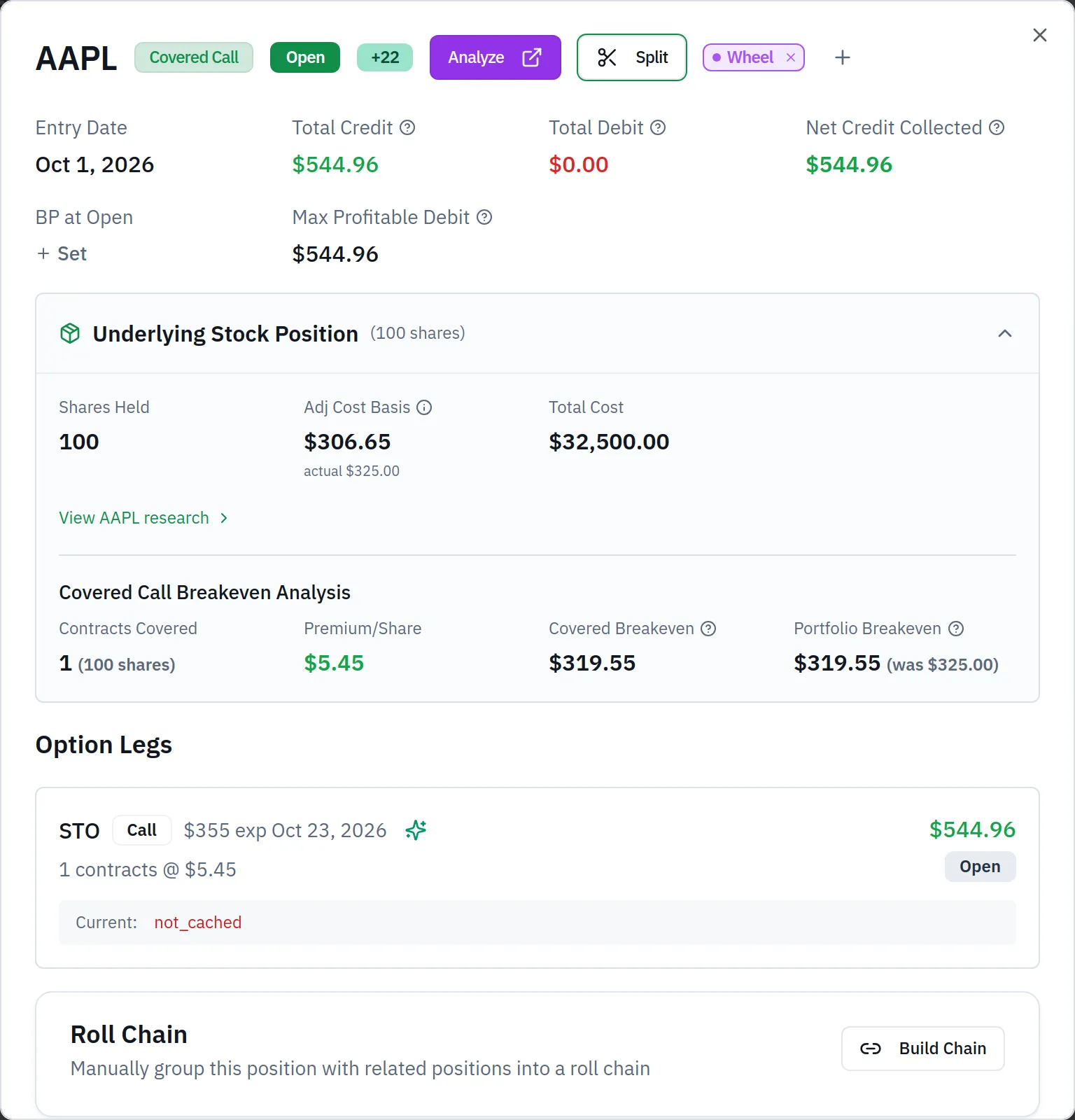
If the Greeks block is missing entirely, that is deliberate: unrealized-derived sections, including per-leg Greeks and position Greeks, do not render without a usable quote, and missing quote data is not treated as zero. Use Refresh Prices in the site header to fetch delayed prices.
The second place is the Position Analyzer under Research, where you build legs yourself rather than reading an existing position. Its Position Greeks and IV panel aggregates exposure across all legs, signed for long or short direction and scaled by quantity — the same two adjustments your sign-and-multiply step performs. In the Table view, the Columns menu can show Delta, Gamma, Theta, Vega, Rho, IV, Volume and Open Interest beside the base leg columns, so you can inspect leg by leg the way the worksheet does. Delta is available on the public analyzer page; Gamma, Theta, Vega and Rho require Pro, and non-Pro users can expose those columns but the non-Delta Greek cells remain locked.
From Open Positions, Open in Position Analyzer in the Analyze column opens a new tab with the position's open option legs already filled in, which is the quickest way to take a live holding and start changing one input at a time.

The analyzer is also where the "what changes the outcome" section becomes interactive. Days forward moves the dashed Today curve to a future date so you can see time decay rather than infer it from theta; IV adjustment spans −50 to +100 volatility points so you can price a volatility change rather than multiply vega by hand. Pro users can put Delta, Gamma, Theta or Vega on the Profit / loss diagram itself, and in a multi-leg Greek view the hover detail breaks the aggregate value down by leg. Selecting a Greek also switches the Profit / loss heatmap from P/L to that position Greek at each price-and-date combination — a direct picture of how your 36 delta drifts as price and time change.
Throughout both screens, quotes are delayed and the Greeks are model estimates based on available quote and contract inputs. Where complete market data is unavailable, the analyzer can use Black-Scholes estimates and marks values as estimated.
Common mistakes
- Forgetting the sign on a short leg. Short puts have positive delta and positive theta, not negative. Fix: write quantities as signed numbers (−2, +2) before you multiply anything.
- Comparing a per-share Greek with a position Greek. A −0.3 delta and a 60 delta are the same leg in different units. Fix: check the label, and scale by signed contracts × multiplier before comparing.
- Assuming every contract is 100 shares. Mini options use 10, and futures options use a broker-supplied multiplier. Fix: confirm the contract size, then put that number in the formula instead of 100.
- Treating theta as a daily paycheque. $4 per day is today's rate under unchanged price and volatility, not an amount that accrues on a schedule. Fix: recalculate after any meaningful move, and read theta alongside delta and vega.
- Judging direction by the short strike alone. The long 45 wing cut net delta from 60 to 36 and nearly cancelled vega. Fix: total every leg before describing the position's exposure.
- Reading blank Greeks as zero exposure. Position details suppresses Greeks and unrealized figures when there is no usable quote. Fix: use Refresh Prices in the site header, then reopen the position.
- Expecting the Greeks to price a big move. Delta describes a $1 move, vega a one-point IV move; a gap breaks both because gamma reshapes delta on the way. Fix: use the analyzer's P/L diagram or heatmap to model larger moves, remembering those are scenario calculations, not forecasts.
Related guides and help pages
Related guides
- Calls and Puts: What an Option Contract Actually Is
- Contract size and the 100-share multiplier
- Plan, Track, Optimize: a complete tour of MetisTrades
- PMCC Short Call Went ITM: Roll, Close Both, or Exercise the LEAPS?
- Premium, Credits and Debits: How Option P/L Is Counted
- Reading a payoff diagram: profit and loss at expiration