Contract size and the 100-share multiplier
An option quote of 1.50 is a price per share, not the cost of the contract. This guide shows how the multiplier turns a per-share quote into dollars, what changes when a contract is not 100 shares, and where the multiplied figures appear in MetisTrades.
What it is and why it matters
An option quote is a price per share of the underlying, not the price of the contract. When a screen shows a put at 1.50, that 1.50 is what one share of exposure costs. To find out how many dollars leave or enter your account, you multiply by the contract size — the number of underlying units one contract represents — and then by the number of contracts.
Standard US equity options usually use a contract size of 100 shares. That number is a convention, not a law of nature. Mini options use 10. Futures options use a multiplier supplied by the broker that depends on the contract. As the MetisTrades glossary puts it, contract size "is not always 100".
Three terms sit underneath this idea, and they are worth fixing in place before the arithmetic:
- Premium — the price of the option, quoted per share. The buyer pays it; the seller receives it.
- Multiplier (contract size) — the number of underlying units one contract covers. It converts the per-share quote into money.
- Strike — the fixed price at which a call holder may buy, or a put holder may sell, if the contract is exercised. Multiply the strike by the shares a contract covers and you get the notional: the dollar size of the obligation or right behind the position.
Why care? Because almost every number that matters downstream is built on the multiplier. The cash you collect for selling a put, the collateral that put ties up, the dollars at risk in a spread, the position delta, the daily theta — all of them come from a per-share model output scaled by quantity and contract size. Get the multiplier wrong by a factor of ten and every one of those figures is wrong by a factor of ten.
The failure mode is predictable. A trader sees a 1.50 premium, thinks "cheap", sells three of them, and only discovers at assignment that the position carried a 15,000-dollar obligation. Nothing in that sequence is exotic; it is arithmetic that was never done.
Work it out by hand
Take one underlying, call it XYZ, and one option: the 50-strike put, quoted at 1.50. We will price it three ways — as a single standard contract, as three standard contracts, and as three mini contracts with a multiplier of 10 — and keep every other input identical so the only thing moving is contract size and quantity.
Step 1: read the quote as a per-share price
The quote is 1.50. That is 1.50 per share of XYZ exposure. On its own it tells you nothing about dollars, because you do not yet know how many shares the contract covers.
Step 2: premium per contract = quoted price × multiplier
For a standard contract: 1.50 × 100 = 150. One contract costs the buyer 150 dollars and pays the seller 150 dollars, before fees.
For the mini, with a multiplier of 10: 1.50 × 10 = 15. Same quote, same strike, same expiration — one tenth the money, because the contract covers one tenth the shares.
Step 3: total premium = premium per contract × contracts
One standard contract: 150 × 1 = 150. Three standard contracts: 150 × 3 = 450. Three minis: 15 × 3 = 45.
Note the order of operations. The multiplier converts price into dollars per contract; quantity then scales the dollars. Doing it the other way round (1.50 × 3 = 4.50, then × 100 = 450) gives the same answer here, but the two-step version keeps "what one contract is worth" visible, which is the number you will need again for fees, for Greeks, and for reading a broker confirmation.
Step 4: shares controlled = multiplier × contracts
One standard contract covers 100 × 1 = 100 shares. Three standard contracts cover 100 × 3 = 300 shares. Three minis cover 10 × 3 = 30 shares. This is the figure that tells you what happens on assignment: how many shares you would be buying or selling.
Step 5: notional at strike = strike × shares controlled
One standard put: 50 × 100 = 5,000. Three standard puts: 50 × 300 = 15,000. Three minis: 50 × 30 = 1,500.
For a short put, that notional is the cash a cash-secured seller sets aside — the amount needed to buy the shares at the strike if assigned. It is roughly 33 times the 450 of premium collected on the three standard contracts. That ratio is the point of the exercise: the premium is the small number, the notional is the big one, and the multiplier is what connects them.
The spreadsheet below contains these three rows and the formulas behind them, so you can change a quote, a multiplier or a quantity and watch each computed column move.
Download the template: Contract value calculator (.xlsx). It opens in Excel, and in Google Sheets via File → Import. The worked example from this guide is already filled in, and the formulas carry down into the blank rows.
| Contract | Quoted price | Multiplier | Contracts | Premium per contract | Total premium | Strike | Shares controlled | Notional at strike |
|---|---|---|---|---|---|---|---|---|
| XYZ 50 put, standard | 1.50 | 100 | 1 | 150 | 150 | 50 | 100 | 5,000 |
| XYZ 50 put, standard | 1.50 | 100 | 3 | 150 | 450 | 50 | 300 | 15,000 |
| XYZ 50 put, mini (10) | 1.50 | 10 | 3 | 15 | 45 | 50 | 30 | 1,500 |
| Totals | 645 | 21,500 |
Across all three rows, total premium is 150 + 450 + 45 = 645 and total notional at strike is 5,000 + 15,000 + 1,500 = 21,500. Those totals are the honest size of the book: 645 dollars collected against 21,500 dollars of obligation if every put were assigned. Neither number means much without the other.
The worked figures exclude commissions and fees, which your broker charges separately and usually per contract. The next section shows why that distinction bites hardest on small-multiplier contracts.
What changes the outcome
Each change below moves exactly one input from the three-standard-contract row (1.50 × 100 × 3 = 450 premium, 300 shares, 15,000 notional) and leaves everything else alone.
The multiplier
Change 100 to 10 and total premium falls from 450 to 45, shares controlled from 300 to 30, notional from 15,000 to 1,500. Every dollar figure divides by ten; the quoted price does not change at all. This is the only input in the whole calculation that can silently differ between two contracts that look identical on a quote screen.
The quoted price
Move the quote from 1.50 to 1.65 — an extra 15 cents per share. Premium per contract becomes 1.65 × 100 = 165, and three contracts bring 495 instead of 450. Fifteen cents of quote is 45 dollars of money. The multiplier is also a magnifier of small price differences, which is why the gap between bid and ask matters more than it looks.
Time and volatility
Time decay and implied volatility move the quote, never the multiplier. Suppose the put you sold for 1.50 can later be bought back at 0.40. The cost to close three standard contracts is 0.40 × 100 × 3 = 120, so the premium result is 450 − 120 = 330. Run the same close on three minis and it is 0.40 × 10 × 3 = 12, against 45 collected, for 33. Same percentage, one tenth the dollars.
The strike
Drop the strike from 50 to 45 and the notional on three standard puts becomes 45 × 300 = 13,500 rather than 15,000 — 1,500 less capital set aside. The premium would normally fall too, because a lower-strike put is further out of the money, but the notional change is pure arithmetic and independent of the quote.
Quantity
Go from three contracts to one and premium falls 450 to 150 while notional falls 15,000 to 5,000. Quantity scales both sides proportionally, which is why "how many contracts" is a capital decision more than a price decision.
Fees
Say your broker charges 0.65 per contract. On three standard contracts that is 1.95 against 450 collected — about 0.4% of the premium. On three minis it is the same 1.95 against 45 collected — about 4.3%. Per-contract fees do not shrink with the multiplier, so smaller contracts carry proportionally larger costs. Net credit on the three standard contracts is 450 − 1.95 = 448.05.
Non-standard and adjusted contracts
Corporate actions such as splits, mergers and special dividends can leave a contract whose multiplier is still 100 but whose deliverable is not 100 ordinary shares. The symbol may carry a suffix. When you meet one, read the contract specification from your broker rather than assuming the usual 100, and do the premium and notional arithmetic with the deliverable it actually names.
Delta, and why the multiplier appears again
A per-share delta of 0.30 means the option's price moves about 30 cents for a one-dollar move in the stock. Scale it: one standard contract behaves roughly like 0.30 × 100 = 30 shares, three like 90 shares, three minis like 0.30 × 10 × 3 = 9 shares. The glossary states that MetisTrades scales option legs by quantity and contract size when calculating delta, and signs each leg for long or short.
Where you see it in MetisTrades
You meet this arithmetic twice: once inside a single position's legs, and once at the level of the position as a whole.
Position details
Position details is the scrollable dialog you open from an Open Positions or Closed Positions row — Top nav, then Open Positions, then select a row. Its Option Legs section lists calls before puts, higher strikes first, and each leg identifies its transaction code, option type, strike, expiration, quantity, entry value and status. Look at the quantity beside the strike, because that is the number our Step 3 and Step 4 used.
The connection to the hand calculation is explicit in how entry price is defined. The page describes Entry price as the absolute imported leg amount divided by quantity and the contract multiplier — our Step 2 and Step 3 run backwards. For the three standard puts, 450 ÷ 3 ÷ 100 returns 1.50. For the three minis, 45 ÷ 3 ÷ 10 also returns 1.50. The same per-share price is recovered from very different dollar amounts, which is exactly what the multiplier is for.
When delayed prices have been fetched, a priced open leg can also show Current, vs Entry, per-leg unrealized P/L, the underlying Stock price, and bid, ask, mark, volume and open interest when supplied. The per-leg Greeks line carries its own labels: Delta: Price change per $1 stock move, Gamma: Rate of Delta change, Theta: Daily time decay per contract, Vega: Price change per 1% IV move, plus implied volatility. Read the labels as written before you compare a figure with a pencil-and-paper number.
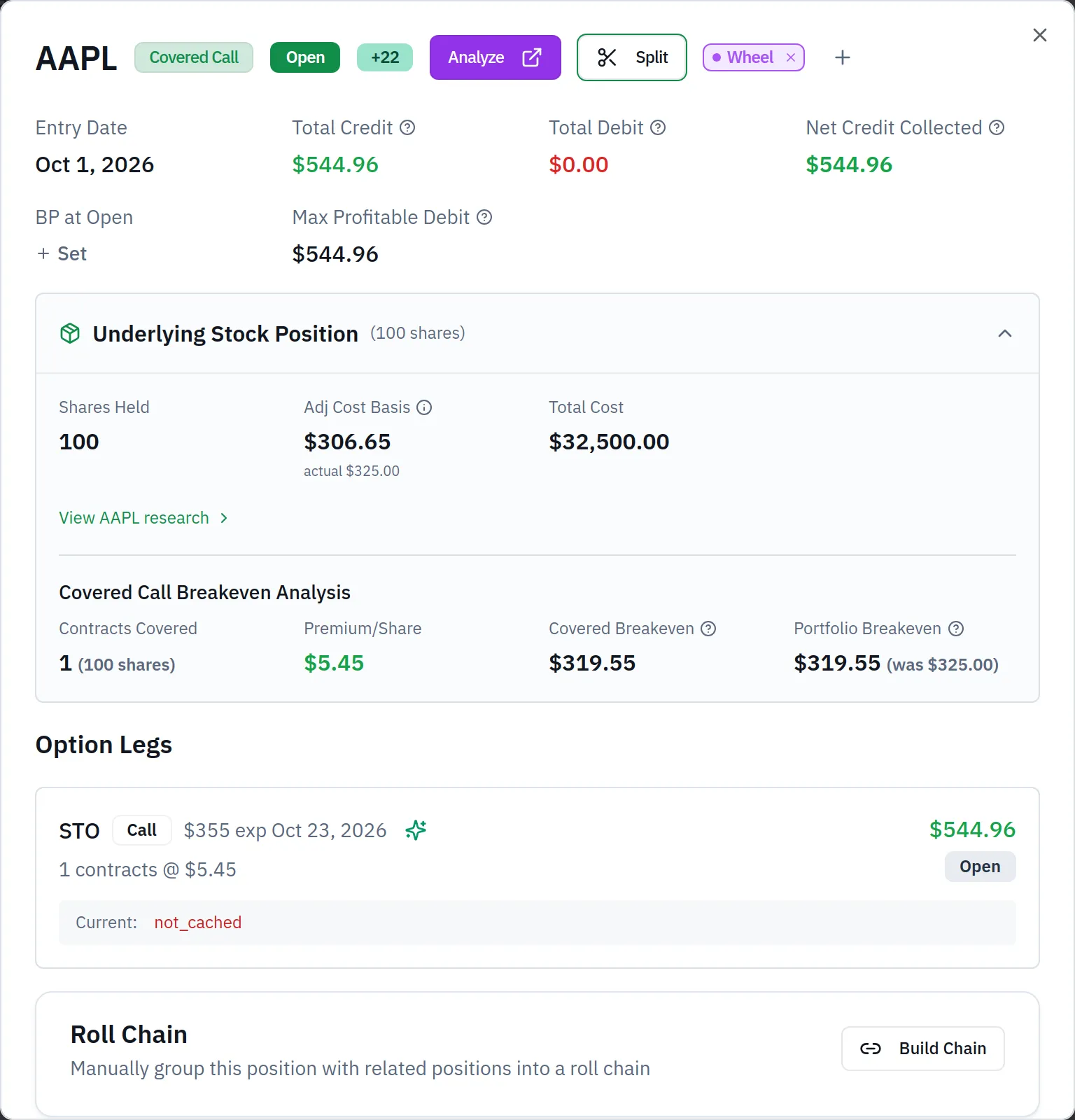
Two practical notes. Unrealized-derived sections — per-leg unrealized P/L, per-leg Greeks and position Greeks — do not render at all without a usable quote; missing data is suppressed rather than shown as zero. If the blocks are blank, use Refresh Prices in the site header. And delayed quotes can lag the market by up to about 15 minutes, with marks described as estimates rather than guaranteed execution prices.
The positions list
Step back out of the dialog to the list you opened it from. Compare the scale of what you see there with the 1.50 you would read on a quote screen, and with the 450 you worked out on paper for three standard contracts.
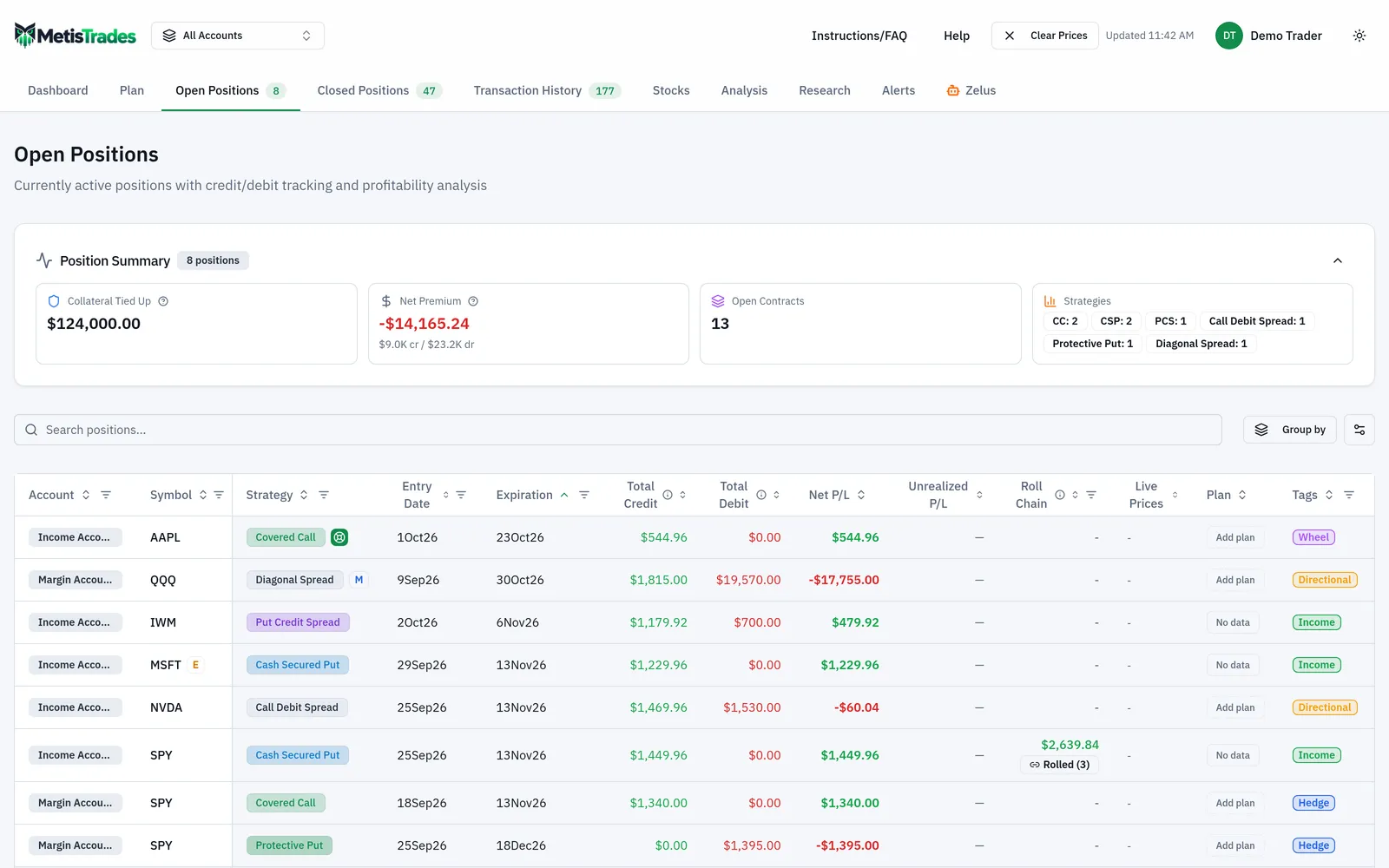
Two glossary definitions are worth holding alongside that view. Standard P/L is profit or loss based only on the position's credits received and debits paid, without adding the current market value of open legs. Live P/L estimates what the open legs would be worth using the latest available option values. Both are built on amounts that already incorporate contract size, and both are estimates derived from your imported transactions. The glossary also lists missing multipliers among the things that can change grouping, cost basis, premium, profit and loss and tax-lot results — so if a position's figures look an order of magnitude off from your own arithmetic, the imported contract size is a reasonable place to start checking.
Common mistakes
- Treating the quote as the cost. "The put is 1.50" is a per-share price, not 1.50 of money. Fix: never write a premium in your records without multiplying by the contract size and the number of contracts.
- Assuming every contract is 100 shares. Mini options use 10 and futures options use a broker-supplied multiplier. Fix: confirm the contract size with your broker before you size the trade, not after the fill.
- Comparing premiums across different contract sizes. A 45-dollar credit on three minis and a 450-dollar credit on three standard contracts are the same 1.50 per share. Fix: compare per-share prices first, then convert to dollars once.
- Sizing on premium instead of notional. Three 50-strike puts collect 450 and commit 15,000 if assigned. Fix: calculate strike × shares controlled before placing the order, and check the cash is there.
- Ignoring per-contract fees on small contracts. The same 1.95 of fees is 0.4% of a 450 credit and 4.3% of a 45 credit. Fix: express fees as a percentage of premium per contract when the multiplier is below 100.
- Assuming an adjusted contract still delivers 100 ordinary shares. Splits and mergers can change the deliverable. Fix: read the contract specification from your broker and redo the notional arithmetic with the stated deliverable.
- Reading a per-share delta as position exposure. A 0.30 delta is not 0.30 shares of exposure. Fix: multiply the per-share delta by quantity and contract size, and sign it for long or short.
Related guides and help pages
Related guides
- Calls and Puts: What an Option Contract Actually Is
- Premium, Credits and Debits: How Option P/L Is Counted
- The Greeks in practice: delta, theta, vega and gamma
- Implied Volatility: What Option Prices Say About Movement
- Assignment and Exercise Explained: Shares, Cash and Basis
- Understanding Roll Chains: Tracking a Rolled Option as One Trade