Calls and Puts: What an Option Contract Actually Is
An option contract gives one side a right and the other side an obligation. Work through one bought call and one sold put on XYZ with exact arithmetic, then see where the same figures appear in MetisTrades.
What it is and why it matters
An option is a contract between two parties about a future transaction in an underlying asset, usually 100 shares of a stock. One side holds a right. The other side carries the matching obligation. Everything else — the jargon, the Greek letters, the strategy names — is built on that one asymmetry.
There are exactly two types of option contract.
- Call — gives its holder the right, but not the obligation, to buy the underlying at the strike by expiration. The call seller accepts the corresponding obligation if assigned.
- Put — gives its holder the right, but not the obligation, to sell the underlying at the strike by expiration. The put seller accepts the corresponding obligation if assigned.
Four terms describe any single contract:
- Underlying — the stock (or other asset) the contract is written on. In this guide it is a made-up ticker, XYZ.
- Strike — the fixed price at which a call holder may buy, or a put holder may sell, if the contract is exercised.
- Expiration — the date after which the contract no longer exists. Before then it can be closed, exercised, assigned, or left to expire worthless. Days to expiration is abbreviated DTE.
- Premium — the price of the contract, quoted per share. Multiply by the contract size to get dollars. Standard equity options usually represent 100 shares, but mini options use 10 and futures options use a broker-supplied multiplier, so do not assume 100 without checking.
Two more words tie it together. Exercise is the holder's action: using the right to buy (call) or sell (put) at the strike. Assignment is what lands on a seller when a holder exercises — a short put assignment normally buys shares at the strike, a short call assignment normally sells shares at the strike.
Why care about the distinction? Because it decides your risk shape before you look at a single chart. A buyer pays premium up front and cannot lose more than that premium plus fees, but has to be right about direction and timing. A seller collects premium up front and keeps it if nothing happens, but carries an obligation that can cost far more than the premium collected. Record keeping follows the same split: a bought option is a debit you are trying to recover, a sold option is a credit you are trying to keep.
Work it out by hand
Take XYZ trading at $50.00. We will price two separate trades, 30 days to expiration, one contract each, 100 shares per contract. These are two independent positions, not a combined strategy.
Trade 1: buy one XYZ 52.50 call for $1.20
You pay the premium: $1.20 per share × 100 shares = $120 debit. That $120 is the most you can lose on this contract, before fees.
The strike is $52.50 and XYZ is at $50.00, so the call is out of the money (OTM): it has no intrinsic value today. Intrinsic value is what the option would be worth if exercised immediately — for a call, the amount the underlying is above the strike, with a floor of zero. 50.00 − 52.50 is negative, so intrinsic value is $0.00. The entire $1.20 is extrinsic value: the part of the price that reflects remaining time, implied volatility and demand, and that decays toward zero by expiration.
Breakeven at expiration is strike plus premium: 52.50 + 1.20 = $53.70. XYZ has to finish above $53.70 for this contract to show a profit, not merely above $52.50.
Trade 2: sell one XYZ 47.50 put for $0.95
You collect 0.95 × 100 = $95 credit. In exchange you accept the obligation to buy 100 XYZ shares at $47.50 if the holder exercises.
The strike is below the $50.00 spot price, so this put is also out of the money and its $0.95 is all extrinsic value. Breakeven is strike minus premium: 47.50 − 0.95 = $46.55.
Maximum loss is not the $95. If XYZ went to zero you would still be obliged to pay $47.50 a share: 47.50 × 100 = $4,750, less the $95 already collected = $4,655. That is the number to write down before placing the trade.
The payoff table
For each XYZ price at expiration, the long call's result is (intrinsic value × 100) − 120. The short put's result is 95 − (intrinsic value × 100). Put intrinsic value is the amount the underlying is below the strike, floored at zero.
| XYZ at expiration | Call intrinsic (per share) | Long 52.50 call P/L | Put intrinsic (per share) | Short 47.50 put P/L |
|---|---|---|---|---|
| $44.00 | $0.00 | −$120 | $3.50 | −$255 |
| $46.55 | $0.00 | −$120 | $0.95 | $0 (breakeven) |
| $47.50 | $0.00 | −$120 | $0.00 | +$95 |
| $50.00 | $0.00 | −$120 | $0.00 | +$95 |
| $52.50 | $0.00 | −$120 | $0.00 | +$95 |
| $53.70 | $1.20 | $0 (breakeven) | $0.00 | +$95 |
| $56.00 | $3.50 | +$230 | $0.00 | +$95 |
| $60.00 | $7.50 | +$630 | $0.00 | +$95 |
Read the two columns as different shapes. The call column is flat at −$120 across a wide band of prices, then rises without a ceiling: a known, limited cost and an uncapped payoff that requires a move. The put column is flat at +$95 across everything from $47.50 upward — the seller's best case is simply keeping the credit — and then falls away steeply below the strike.
Check one row by hand. At $56.00 the call is in the money (ITM) by 56.00 − 52.50 = $3.50 per share, worth 3.50 × 100 = $350. Subtract the $120 you paid: +$230. At $44.00 the put holder exercises; you buy 100 shares at $47.50 while they are worth $44.00, a $3.50 per-share loss, or $350. Subtract the $95 you kept: −$255. If you are assigned, you own the shares at a cost of $47.50 each, and the $95 credit reduces your effective entry to $46.55 — which is why the breakeven and the assignment price are the same arithmetic viewed from two angles.
What changes the outcome
Each change below alters exactly one input of the worked example.
Underlying price
Move the expiration price from $56.00 to $54.00. Call intrinsic becomes 54.00 − 52.50 = $1.50, so $150 − $120 = +$30 instead of +$230. A $2.00 difference in the stock swung the contract's result by $200, because one contract controls 100 shares. Leverage cuts both directions.
Strike
Buy the 50.00 call instead of the 52.50 call. It is at the money, so it costs more — say $2.60, or a $260 debit. Breakeven becomes 50.00 + 2.60 = $52.60, lower than $53.70, and at $56.00 the result is (6.00 × 100) − 260 = +$340. You paid $140 more for a closer strike, a nearer breakeven and more risk if XYZ goes nowhere. Lower strikes are not better; they are a different trade-off.
Time to expiration
Take the same 52.50 call with 7 DTE instead of 30. Less time means less extrinsic value — perhaps $0.45, a $45 debit and a $52.95 breakeven. Cheaper, but XYZ now has one week rather than a month to travel. Extrinsic value decays toward zero by expiration, so the 30-day call's entire $1.20 disappears if XYZ sits at $50.00 and never moves.
Implied volatility
Implied volatility (IV) is the level of future movement implied by an option's market price. It is not a direction forecast. Raise IV and both premiums rise: the 52.50 call might cost $1.65 instead of $1.20. Your max loss becomes $165, breakeven moves up to $54.15, and the $56.00 outcome falls to $350 − $165 = +$185. The same stock move pays less because you paid more for the right.
Position size
Three call contracts instead of one: $360 debit, and +$690 at $56.00 — the shape is identical, the dollars triple. Three short puts: $285 credit, −$765 at $44.00, and a cash-securing requirement of 3 × $4,750 = $14,250 if you intend to buy the shares on assignment.
Fees
Add $0.65 per contract each way. The call's $230 gain at $56.00 becomes $350 − $120 − $1.30 = $228.70, and the true breakeven edges from $53.70 to about $53.71. The short put's $95 credit becomes $94.35 if it expires worthless with only an opening fee. Small per trade, material over hundreds of trades, which is why fees belong in your records.
Contract size
Every dollar figure above assumed 100 shares per contract. On a mini option at 10 shares, the same $1.20 premium is a $12 debit and the $56.00 outcome is +$23. Check the multiplier before you multiply.
Where you see it in MetisTrades
The Position Analyzer is where the hand calculation becomes a screen. Enter a ticker in Symbol and select Load; the page shows the Underlying price when data is available. Then select Add leg and choose Option leg, where you set Side (Buy (long) or Sell (short)), Type (Call or Put), Expiration, Strike, Quantity, Price (per share) and IV (%). Those are the four contract terms from the first section, in the same order. Available quote details appear as Bid, Mid and Ask. Quantity means contracts, entry premiums are entered per share, and option P/L applies the 100-share contract multiplier — exactly the $1.20 × 100 = $120 step you did by hand.
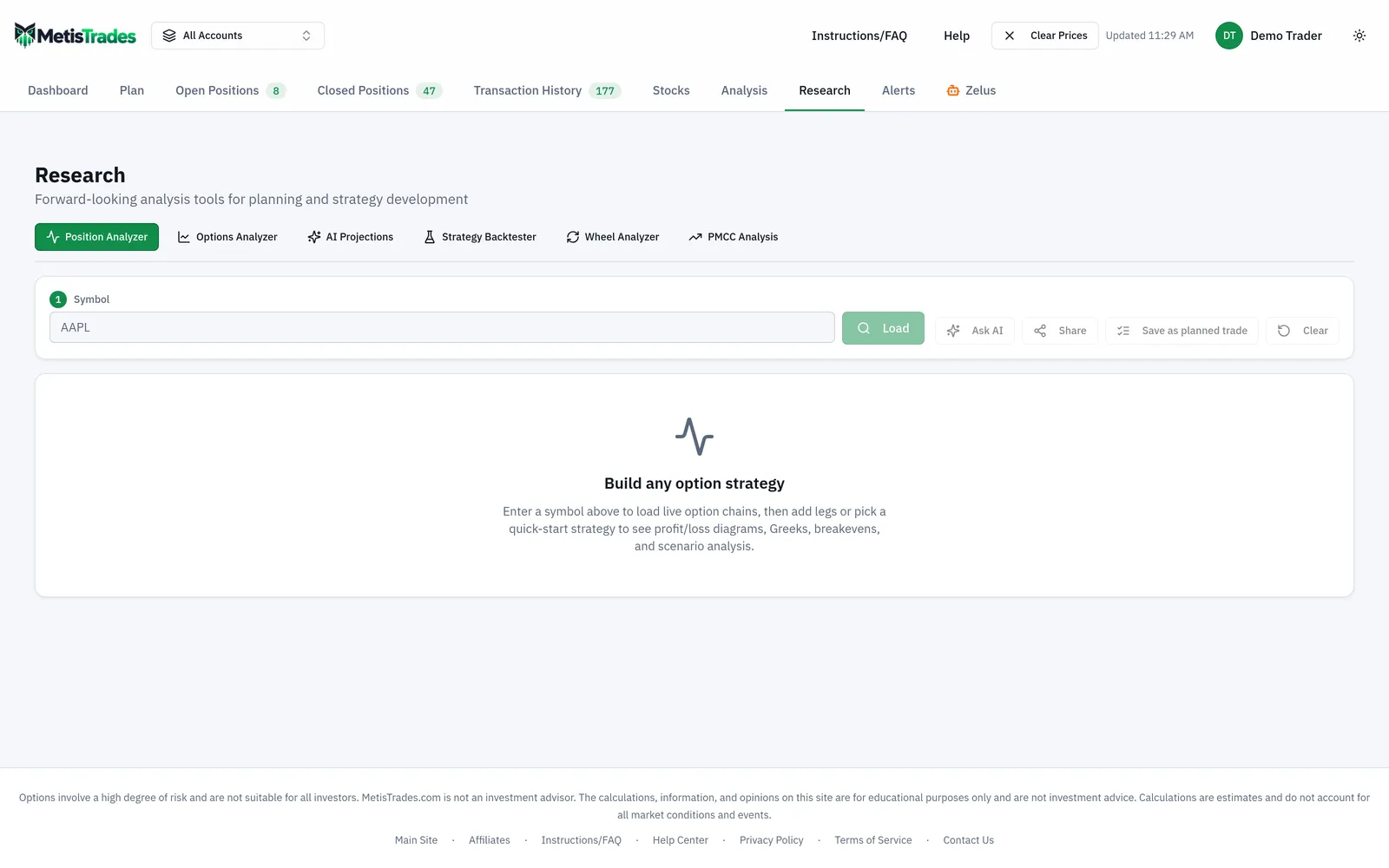
With the leg in place, Payoff at expiration shows Net debit/credit, Breakevens, Max profit and Max loss. For the bought call that is a $120 net debit, a $53.70 breakeven, max loss $120 and max profit Unlimited, since the upside grows without bound. For the sold put it is a $95 net credit with a $46.55 breakeven. The Profit / loss diagram draws the same table as a curve: the solid green and red line is At expiration, the dashed line is Today (or the date you pick with Days forward), Spot marks the latest available underlying price and BE marks the expiration breakevens. The gap between the two curves is the extrinsic value you read about above. Move IV adjustment from −50 to +100 volatility points to see the volatility change modelled for you.
The Price control decides which chain price fills your legs: Mid is the bid/ask midpoint, Natural is the ask for a long leg and the bid for a short leg — a less favourable but more conservative assumption. Natural is the default. When the available spread is stale from a prior session the page forces Mid and hides Natural. Quotes are delayed throughout, so every mark is the latest available value, not a guaranteed fill. Delta — the approximate position-value change for a $1 move in the underlying — is available on the public page, while Probability of profit, Expected value, Tail risk (avg worst 5%) and the non-Delta Greeks require Pro.
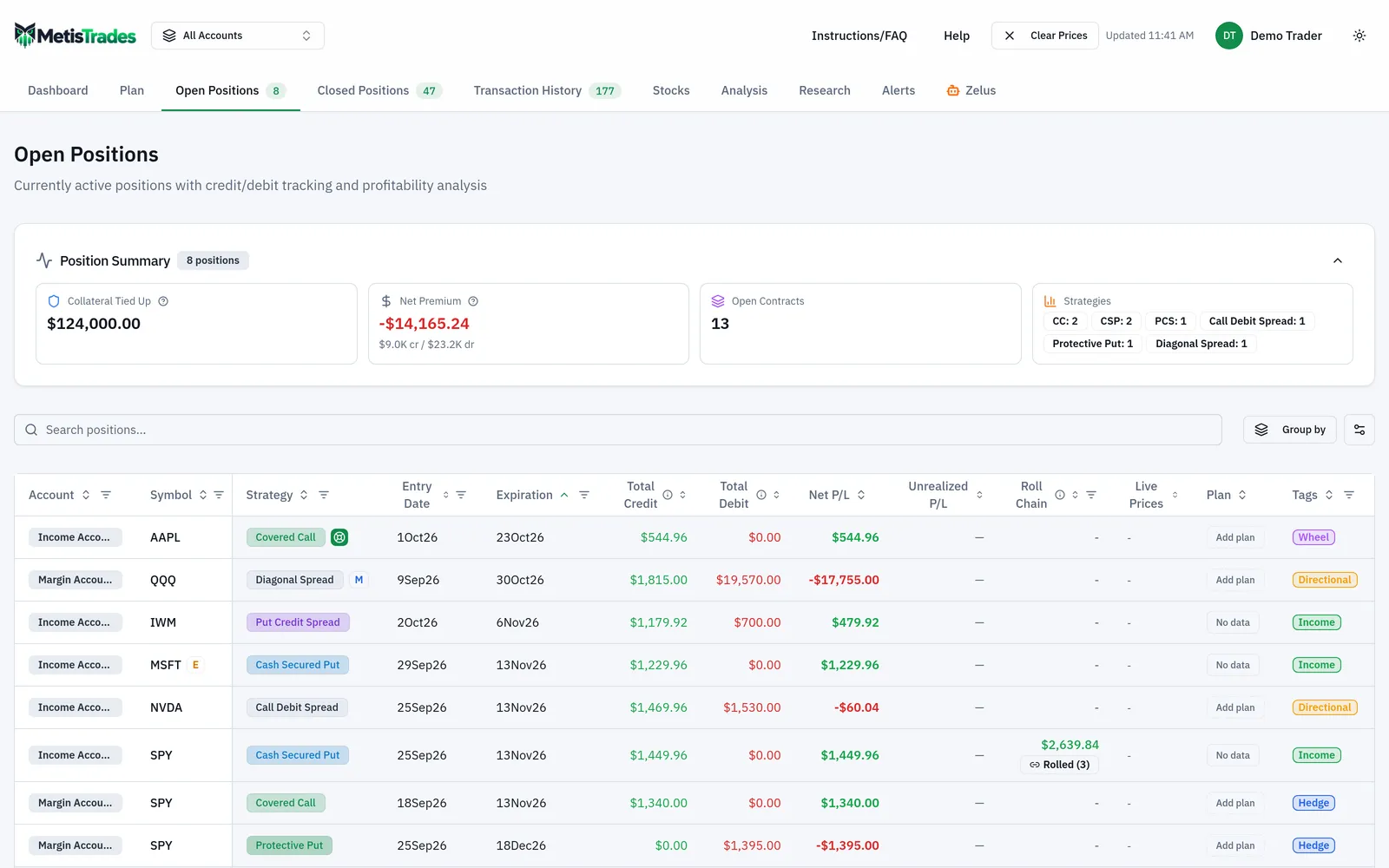
Once your broker activity is imported, your live contracts live on Open Positions. The control that matters for this guide is in the Analyze column: Open in Position Analyzer opens a new tab with the position's open option legs already filled in, so you can check a real contract's breakeven and payoff against the arithmetic you just did. A covered call or protective put can include matching shares, so the combined payoff includes the stock.
Common mistakes
- Reading the premium as the cost of the contract. $1.20 is per share; the contract costs $120. Multiply by the contract size every time.
- Assuming every contract is 100 shares. Mini options use 10 and futures options use a broker-supplied multiplier. Confirm the multiplier before calculating dollars.
- Treating the strike as the breakeven. The bought 52.50 call only breaks even at $53.70. Add the premium for a call, subtract it for a put.
- Thinking a sold put risks only the credit. The $95 credit sits against a $4,655 worst case. Write down strike × contract size minus credit before you sell.
- Mixing up exercise and assignment. Exercise is the holder's choice; assignment is the obligation that lands on the seller. If you are short, you do not choose.
- Calling an out-of-the-money option worthless. It has no intrinsic value, but its extrinsic value is real money until expiration — $1.20 a share here.
- Treating a displayed mark as a fill price. Quotes are delayed and Mid and Natural are assumptions; compare both and expect your actual fill to differ.
Related guides and help pages
Related guides
- Premium, Credits and Debits: How Option P/L Is Counted
- Contract size and the 100-share multiplier
- Reading a payoff diagram: profit and loss at expiration
- The Greeks in practice: delta, theta, vega and gamma
- Implied Volatility: What Option Prices Say About Movement
- Assignment and Exercise Explained: Shares, Cash and Basis