PMCC short call in the money: roll it, close both legs, or exercise the LEAPS?
Your poor man's covered call has an in-the-money short call and only a long call behind it. We price the three exits on one example position and show which numbers decide it.

Your poor man's covered call did what you hoped for, mostly. The stock ran right through your short strike, and now you're staring at an in-the-money short call with no shares behind it. Just a long call. So, do you roll it, close the whole thing, or exercise the LEAPS if you get assigned? This post puts a dollar figure on each of those exits using one example position, then gives you a rule for picking.
The situation
Quick refresher first.
A poor man's covered call (PMCC) – a long-dated, deep in-the-money call (the "LEAPS") that stands in for 100 shares, with shorter-dated calls sold against it.
In the money (ITM) – for a call, the stock is above the strike.
Assignment – the person who bought your short call exercises it, and you have to deliver 100 shares at the strike.
And there's the problem.
With a regular covered call, assignment is boring. Your shares go out the door, you get the strike price, done. With a PMCC you don't OWN shares. If you're assigned, your broker delivers shares you don't have, which generally leaves you short 100 shares until you fix it.
So the question you're actually asking is:
"My short call is in the money. How worried should I be, and what's the cheapest way out?"
It's not obvious because the three common answers (roll, close, exercise) all sound reasonable in a one-line list. They don't cost the same. Not even close.
How urgent is it, really?
Early assignment isn't random. The person holding your call would usually rather sell it than exercise it, because exercising throws away the option's time value.
Time value (also called extrinsic value) – the part of an option's price above what it's in the money by.
So the urgency check is simple:
Time value left on the short call – if there's still a decent chunk, early exercise usually makes little sense for the holder.
Days to expiration – time value shrinks as expiration gets close, so the risk climbs in the last week or two.
Dividends – if a dividend is coming and the time value left on your short call is smaller than that dividend, a call holder may exercise the day before the ex-dividend date to collect it. That's the classic early-assignment trigger.
Then there's the stock moving further up, which shrinks time value even more. Deep ITM calls trade almost entirely on intrinsic value.
The point is, the risk is low until it isn't. And when it isn't, you want to have already decided what you'll do.
The realistic choices
Let's go down the list.
1. Roll the short call up and out
Buy back the ITM short call and sell a later-dated call at a higher strike. ie. kick the can down the road, and up.
What it buys you: you stay in the trade, and a higher strike can raise what you'd collect if the stock keeps running.
What it gives up: when the short call is deep ITM, rolling up often costs a debit (money out), not a credit. You also keep all your capital tied up, with all the downside still in play.
2. Close both legs
Sell the LEAPS, buy back the short call, walk away.
What it buys you: a known result today. No assignment, no short shares, no guessing.
What it gives up: any further upside. And you pay two bid/ask spreads plus commissions on the way out.
3. Do nothing, get assigned, then exercise the LEAPS
Let the short call ride. If you're assigned, exercise the long call to buy the shares at its strike and deliver them.
What it buys you: simplicity. One exercise notice, the short shares go away.
What it gives up: every penny of time value left in the LEAPS. When you exercise, you only get the in-the-money part of the long call. The rest just… evaporates.
(There's a fourth flavor: get assigned, then buy 100 shares in the market and sell the LEAPS separately. That avoids throwing away the LEAPS time value, but it means two trades on two different instruments, and you're short shares until they're both done. Economically it lands close to closing both legs.)
The worked example
Let's run the scenarios. These are illustrative example prices, NOT a live quote.
AAPL at $214.00.
Long 1 AAPL $160 call, about 300 days out, bought for $52.00.
Short 1 AAPL $205 call, 14 days left, sold for $3.20.
Today the short call marks at $10.40, and the long call marks at $62.50.
A 42-day $215 call bids $9.60, so rolling up and out costs a $0.80 debit.
Net debit paid so far – $52.00 out, $3.20 in, so $48.80 per share net out (that's the −48.8 you'll see in the sheet).
Notice that the short call marks a little above what it's in the money by. So there's still a sliver of time value left on it. Not much, though, and 14 days isn't long.
Here's the position in the Position Analyzer with both legs filled in. Look at the green and red curve near the right side of the chart, where it goes flat above the $205 short strike, and at the stats under Payoff at expiration.
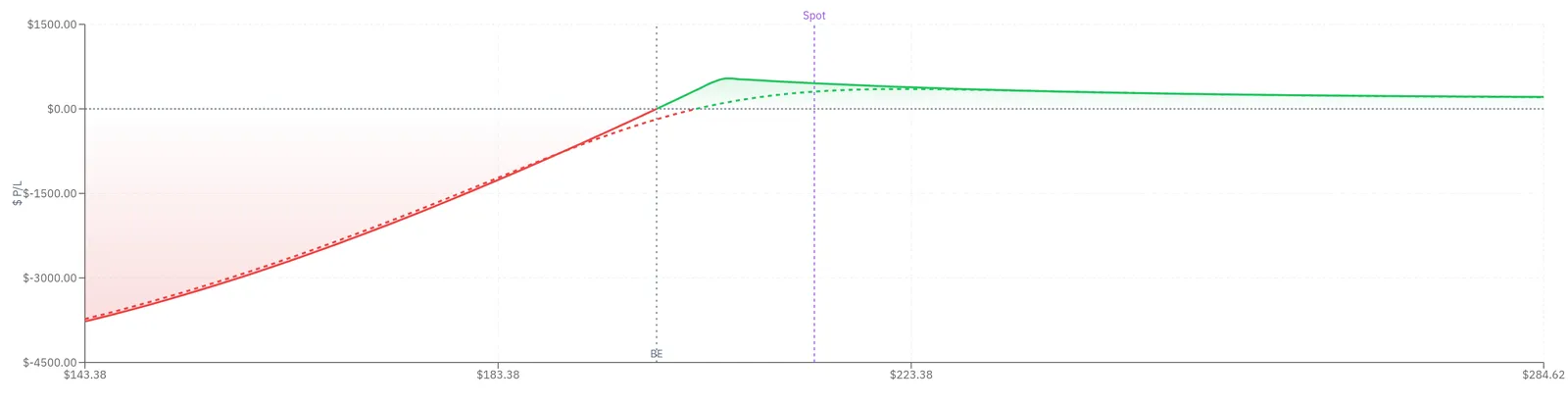
The worked example in the Position Analyzer: Poor man's covered call with the short call in the money, at the example's share price of $214.00.
Every choice below runs through the same spreadsheet, with the formulas already in it. Download it and change the numbers to check me.
Download the template: Poor man's covered call with the short call in the money — choices compared (.xlsx). It opens in Excel, and in Google Sheets via File → Import. The worked example from this guide is already filled in, and the formulas carry down into the blank rows.
Choice | Cash today | Capital tied up | Breakeven if you exercise | Locked-in P/L if you end flat | Worst case (stock to $0) | P/L if called away at the short strike |
|---|---|---|---|---|---|---|
Roll to the 42-day $215 call | −$80 | $6,250 | $209.60 | $0 (still open) | −$4,960 | +$540 |
Close both legs now | +$5,210 | $0 | none open | +$330 | +$330 | none open |
Leave it, get assigned, exercise the LEAPS | $0 | $6,250 | $208.80 | $0 (still open) | −$4,880 | −$380 |
How the columns are built (per share figures, times 100 for one contract):
Cash today = cash per share × 100; ie. −0.80 × 100 = −$80 for the roll, and 52.10 × 100 = $5,210 for closing both ($62.50 in from the LEAPS, $10.40 out for the short call).
Locked-in P/L = (net cash before + cash today) × 100; ie. (−48.80 + 52.10) × 100 = $330.
Breakeven if you exercise = long strike − net cash before − cash today; ie. 160 + 48.80 + 0.80 = $209.60 for the roll, and 160 + 48.80 = $208.80 for doing nothing.
P/L if called away = (net cash before + cash today + short strike − long strike) × 100; ie. (−48.80 − 0.80 + 215 − 160) × 100 = $540 for the roll, and (−48.80 + 205 − 160) × 100 = −$380 for doing nothing.
Capital tied up = the LEAPS mark × 100; ie. 62.50 × 100 = $6,250.
What the table is saying
Close both: +$330, banked, done. That's the whole trade's result, and nothing about it depends on where AAPL goes next.
Leave it and exercise if assigned: −$380.
Wait, what?! The stock went UP past your strike and you lose money?
"This is BS!! The trade worked!!1!"
It did work. The exercise is what breaks it. Two things are going on.
First, your short strike ($205) sits less than $48.80 above your long strike ($160). So even in the "best" case, where you exercise at $160 and deliver at $205, the gap between the strikes doesn't cover what you paid. The structure was underwater at the cap from day one.
Second, exercising throws away the LEAPS time value. Closing both sells the long call at its $62.50 mark, time value and all. Exercising only captures the stock-minus-strike part. That difference between +$330 and −$380 is basically the time value you'd be setting on fire.
Roll to $215: −$80 today, and if AAPL is above $215 at the new expiration and you're called away, +$540. Why the swing? The new strike gap ($160 to $215) is now bigger than your all-in cost of $49.60 per share ($48.80 + $0.80). So the cap finally sits above your breakeven.
But, and it's a big but, the roll keeps $6,250 of capital in play, and the worst case if the stock collapses is −$4,960. Closing both has a worst case of +$330, because there's nothing left open to go wrong.
The moral of the story: rolling isn't "free money for being patient." You're trading a sure +$330 for a shot at +$540 with the full downside still attached. I don't know which way AAPL goes over the next 42 days. Neither does anyone else.
The decision rule
The one comparison that matters most:
Strike spread (short strike − LEAPS strike) vs. net debit paid.
That gap is what you lock in if the stock finishes above the short strike and you exercise. If it's negative, assignment-plus-exercise locks in a loss, no matter how far the stock runs.
Simply put:
If the strike spread is SMALLER than your net debit (like this example), then do NOT plan to exercise. Either close both legs, or roll to a strike where the new spread is bigger than your new all-in cost. Check that by adding the roll's debit to your net debit before comparing.
If the strike spread is BIGGER than your net debit, then assignment isn't a disaster on paper. You still lose the LEAPS time value by exercising, so closing both usually comes out ahead of exercising. Then the real question becomes "do I want to stay in this trade?"
If the roll costs a debit, then pay it only if the new spread minus your total cost is positive AND you're comfortable keeping the full capital at risk for the extra weeks.
If the short call's time value is nearly gone, or a dividend is coming that's bigger than that remaining time value, then decide now, before the ex-dividend date. Don't wait for the assignment notice.
If you'd exercise the LEAPS, then only do it when the LEAPS itself has almost no time value left, or there's no reasonable market to sell it into. Otherwise you're paying to exercise.
The honest limits
This rule tells you what each exit does to your numbers. It does NOT tell you what the stock does next. Nothing does.
A few other things it leaves out:
Commissions and fills. Closing both legs and rolling each involve two option trades. An exercise and assignment may carry their own broker fees. Check your broker's schedule.
Margin and settlement. If you're assigned without shares, many brokers will show you short 100 shares, which can tie up margin or trigger a call until it's resolved. Exercise and assignment then settle as stock trades on your broker's timeline. How this shakes out is broker-specific, so look it up before you need it.
Delayed prices. The marks in this example (and anywhere you check them in MetisTrades) are delayed. The roll's $0.80 debit is what the example assumes, not a guarantee of a fill.
Run it on your own numbers
The example position opens in the Position Analyzer with both legs already filled in:
Run it on your own numbers: Open this AAPL example in the MetisTrades Position Analyzer and change the strike, expiration and prices to yours
Once it's open, here's what to change:
Symbol and price. Load your own ticker with Symbol and Load, then rebuild the two legs, or just edit the existing ones.
The long call. Set its Strike, Expiration and Price (per share) to what you actually paid.
The short call. Same thing: your strike, your expiration, your opening credit.
Check the stats. Under Payoff at expiration, look at Net debit/credit, Breakevens and Max profit. A negative or tiny max profit is the strike-spread-vs-net-debit problem showing up on screen.
Try the roll. Change the short leg to the strike and expiration you're considering, with the price you'd sell it for. Then compare the new Max profit and Breakevens with what you had. Add the roll's debit or credit to your spreadsheet row so the cash history stays honest.
A couple of things worth knowing while you're in there:
The Price setting switches between Mid and Natural. Natural uses the ask when buying and the bid when selling, which is the more conservative way to price a roll or a close.
Use Days forward to see the dashed curve at a later date. That's how you see the LEAPS time value still hanging around before expiration.
The analyzer doesn't place, close or roll trades at your broker. It's a calculator. A pretty one, but a calculator.
Want to see the LEAPS time value directly?
PMCC Analysis, under Research, is a separate page for modeling a poor man's covered call before you trade it. You start with a symbol lookup, pick a LEAP expiration and call, and its LEAP Position Summary shows a Premium Breakdown that splits Intrinsic Value from Extrinsic (Time) Value. That extrinsic figure is roughly what you'd throw away by exercising instead of selling. It needs Pro access.
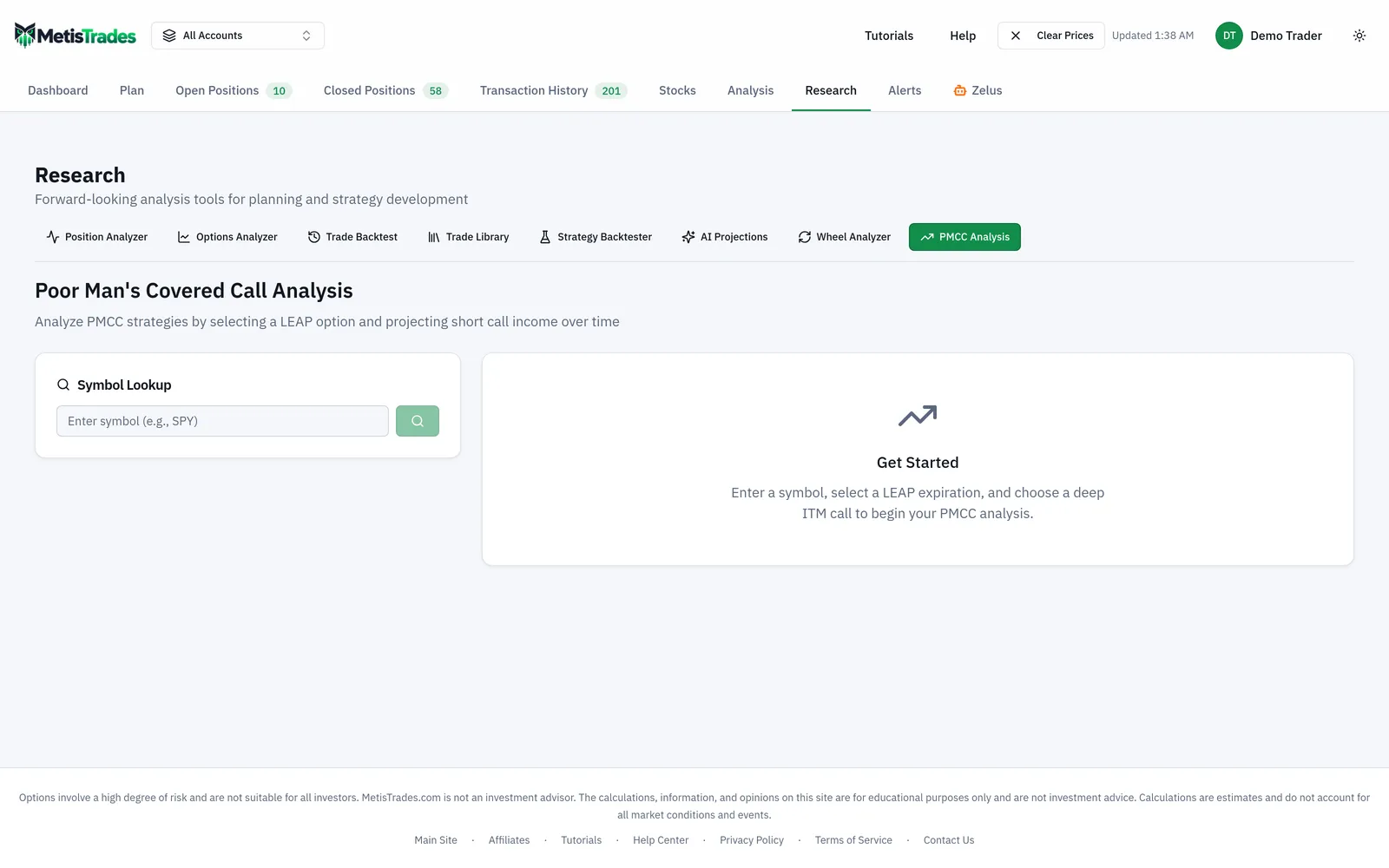
PMCC Analysis under Research, a separate page that models a poor man’s covered call before you trade it, starting from a symbol lookup.
One caveat: PMCC Analysis is a projection tool and never looks at your own trades. To track a PMCC you've actually traded, the help pages point to PMCC Campaigns under Analysis. And if you did get assigned or exercised, the Assign/Exercise page under Analysis picks those events up from your imported broker history.
The short version
It's not "always roll."
It's not "just exercise if assigned."
It's the strike spread against what you paid, plus the time value you'd be tossing.
Please, please, please plug in your own position and see which side of that line you're on. Did walking through the three exits make the choice clearer, or is there a case I didn't cover that you're stuck on?
Try it in MetisTrades: PMCC Analysis
Related guides and help pages
Related guides
Covered call assigned the day before ex-dividend: the check, the cleanup and your choices now
Credit spread short leg assigned early? The cleanup, step by step
Assigned on a Put and the Stock Is 15% Below Your Strike: Where Do You Sell the First Covered Call?
Short option at 80% profit with weeks left: close it and redeploy, or wait?
Your short put is deep in the money with a week left: take assignment, roll, or close?