Your short put is deep in the money with a week left: take assignment, roll, or close?
A short put went deep in the money with 7 days left. We price buying it back, rolling down and out, and taking the shares from the same example marks, then write a rule for choosing.

You sold a put that looked comfortably out of the money, the stock dropped right through your strike, and now there's a week left on the clock. This post prices the three things you can actually do from the same day's example marks, and then hands you a rule for choosing.
The situation
Let's say you sold one AAPL $215 put about a month ago for $3.00. At the time it was roughly a 30-delta put. Delta is the option's sensitivity to a $1 move in the stock, and traders often use it as a loose stand-in for "how likely is this to finish in the money." Thirty felt safe enough.
Then AAPL fell to $198.00. (These are illustrative example prices, NOT a live quote.)
So your put is now about $17 in the money, it has 7 days left, and it marks at $17.40.
The question bouncing around your head goes something like this:
"Do I roll it, do I just take the shares, or do I eat the loss and buy it back?"
Lots of people end up here. Cash-secured put sellers do. Wheel traders do. Anyone who sold premium on a stock that then had a bad month does.
And it's not obvious, because each choice feels different:
- Buying back feels like losing.
- Taking the shares feels like "not losing yet."
- Rolling feels like getting paid to wait.
Feelings are not numbers.
The thing is, these three paths change four separate things: the cash that moves today, your breakeven, how much money stays tied up, and for how long. The rest of this post puts all three side by side so you can see what you're really trading off…
The realistic choices
A few definitions first, so we're speaking the same language:
- Assignment – the put holder exercises and you're required to buy 100 shares per contract at the strike.
- Roll – you buy back the current option and sell a new one in the same order, usually with a later expiration, a different strike, or both.
- Intrinsic value – the part of an option's price that comes purely from the stock being past the strike. For your put, that's the gap between $215 and $198.
- Extrinsic value – everything in the price above intrinsic, ie. what's left for time and volatility. It shrinks toward zero as expiration gets close.
Choice 1 – Buy the put back now
You pay $17.40 per share to close. The trade is over.
What it buys you: a known, final result and your cash back to use for anything else.
What it gives up: any chance of the stock bouncing back toward your strike before expiration. The loss becomes realized, ie. locked in.
Choice 2 – Roll down and out
You buy back the $215 put and sell a 35-day $212.50 put, which bids $18.10. Net, that's a $0.70 credit.
What it buys you: a slightly lower strike, a little more premium, and more time.
What it gives up: your cash stays pinned as collateral for 28 more days, and you're still on the hook to buy the shares, just at $212.50 instead of $215.
For this post, every roll has to pass two guardrails:
- Credit-only – the roll must bring cash in, not cost cash.
- Max +30 days – the new expiration can add no more than 30 days.
This one passes both. A $0.70 credit, and 35 days minus the 7 days left adds 28 days.
But here's the part a lot of write-ups skip over. When a put is THIS deep in the money, almost all of its price is intrinsic value. There's very little extrinsic left to sell. So a credit-only roll inside a 30-day window might not exist at all on your stock, or it might only exist if you keep the strike close to where it is. If nothing passes the guardrails, the rule set is simple: you don't roll. You pick between the other two.
Rolling for a debit just to buy time is a different trade, and this rule set doesn't allow it.
Choice 3 – Take assignment at $215
You do nothing to the option, let it go in the money at expiration (or earlier), and buy 100 shares at $215.
What it buys you: you keep the full $3.00 premium, and you own the shares, so you can sell covered calls on them afterward.
What it gives up: the most capital of any choice gets tied up, with no end date. You now own a stock that's trading well below what you paid for it.
And "do nothing" really IS choice 3 here. With a week left and the put this deep, doing nothing means taking the shares.
The worked example
Everything below comes from one snapshot: AAPL at $198.00, the $215 put marking $17.40, and the 35-day $212.50 put bidding $18.10. Example prices, not a live quote.
The spreadsheet for this post has all three choices already built in, with the formulas visible, and empty rows for your own trades:
Download the template: Short put deep in the money, 7 days left — choices compared (.xlsx). It opens in Excel, and in Google Sheets via File → Import. The worked example from this guide is already filled in, and the formulas carry down into the blank rows.
Here's what it computes:
| Choice | Cash today | Breakeven stock price | Capital tied up | Days added | Locked-in P/L if you end flat | Whole-trade worst case (stock to $0) |
|---|---|---|---|---|---|---|
| Buy the put back now | −$1,740 | none (no position) | $0 | 0 | −$1,440 | −$1,440 |
| Roll to the 35-day $212.50 put | +$70 | $208.80 | $21,250 | 28 | still open | −$20,880 |
| Take assignment at $215 | $0 | $212.00 | $21,500 | 0 | still open | −$21,200 |
Inputs common to every row: original premium $3.00, strike $215, stock $198.00, one contract (100 shares).
Let's go down the list.
Buying back
Cash today = buy-back price × contracts × 100; ie. −17.40 × 1 × 100 = −$1,740.
Locked-in P/L = (premium received + cash today) × 100; ie. (3.00 − 17.40) × 100 = −$1,440.
That's it. No breakeven, because there's nothing left open. No capital tied up. The worst case is the same −$1,440 because nothing else can happen to you.
Not pretty, but it's FINAL.
Rolling
Cash today = 0.70 × 1 × 100 = +$70.
Breakeven = new strike − original premium − roll credit; ie. 212.50 − 3.00 − 0.70 = $208.80.
Capital tied up = new strike × 100 = $21,250, for 28 more days.
Worst case if AAPL went to $0 = (3.00 + 0.70 − 212.50) × 100 = −$20,880.
Notice where the breakeven improvement actually comes from. Most of it is the lower strike, not the credit. The $0.70 is a teeny-tiny slice of that. You're mostly paying to move the strike down by giving back almost the entire extra premium you'd have gotten at $215.
Taking assignment
Cash today = $0. Nothing trades today.
Breakeven = strike − premium; ie. 215 − 3.00 = $212.00.
Capital tied up = $21,500, now sitting in shares with no expiration.
Worst case = (3.00 − 215) × 100 = −$21,200.
What the table means (and doesn't)
So, the honest read:
- The roll and assignment both keep you in the trade. The roll lowers your breakeven from $212.00 to $208.80, and it costs you 28 more days of $21,250 sitting as collateral.
- Buying back is the ONLY choice with a fixed result. Everything else still depends on where AAPL goes.
- With the stock at $198.00, both "stay in" choices are under water on paper. The roll just has a smaller hole to climb out of.
What it does NOT mean: it doesn't mean the roll "saved" anything. It doesn't mean assignment "avoided" a loss.
A quick word on the question people ask most: is buying back at a loss different from taking the shares at a loss? At this exact moment, economically, not by much. Either way the stock fell through your strike and that cost is real. The difference is what happens NEXT. Buying back makes the loss final and frees your cash. Assignment leaves the loss unrealized and keeps the same dollars exposed to whatever AAPL does from here. Neither is "free."
And which one ends up ahead? It depends entirely on where the stock goes, and I don't know which way it moves. Nobody does. A rally toward $215 helps both "stay in" choices. A further drop hurts them, and that's the scenario where buying back looks best in hindsight. The spreadsheet and the Analyzer show you each path at whatever stock price you want to test.
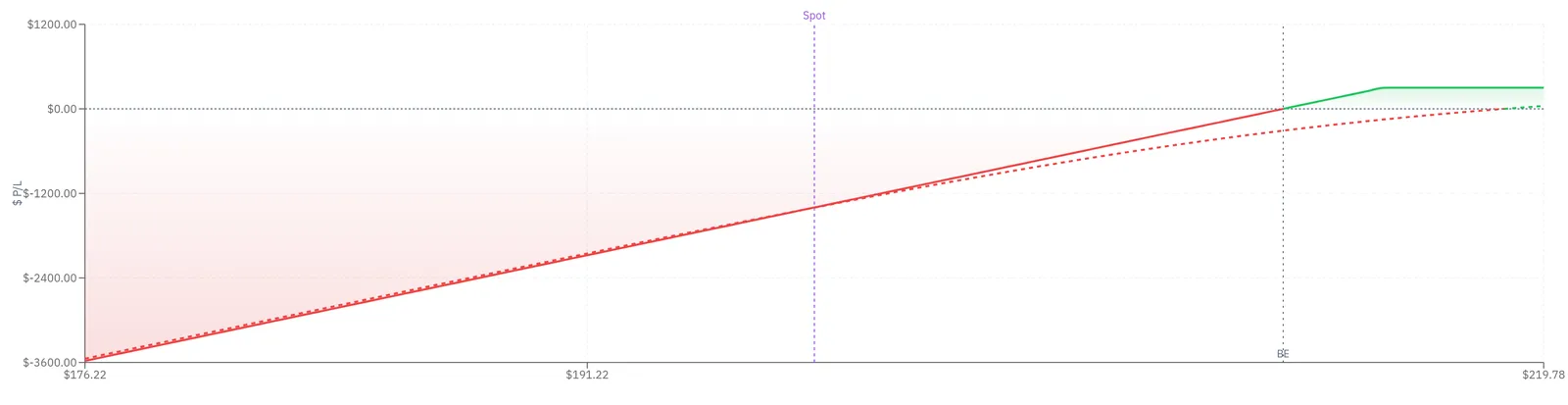
Here's the starting position loaded in the Position Analyzer. Look at the solid expiration curve, where the BE marker sits, and the Spot line at $198.00, which shows how deep in the money the put is right now.
One more wrinkle: early assignment
A deep in-the-money put with very little extrinsic value left is a candidate for early assignment, meaning the holder can exercise before expiration. If that happens, you get choice 3 whether you planned on it or not. So if you're leaning toward the roll or the buy-back, the last week is not the time to "wait and see" for long.
The decision rule
To cut to the chase, here's the rule. It's written as conditions on purpose:
- If no roll passes the guardrails (credit-only, no more than 30 days added), then don't roll. Choose between assignment and buying back.
- If you would NOT buy this stock fresh today at the new strike, then don't roll and don't take assignment. Buy it back. Rolling a put on a stock you don't want is just agreeing to buy it later.
- If a roll passes and you'd happily own the shares at the new strike, then compare the roll's credit per day added (the roll credit ÷ the days added, ie. $70 spread across 28 days in this example) against what those same dollars could earn somewhere else over those days. Roll only if the credit per day wins.
- If you want the shares at your original strike and you're fine having the capital tied up with no end date, then taking assignment is the straightforward choice, and you can sell covered calls against the shares afterward.
- If you want your capital back and a closed book, then buy it back and accept the known result.
"But, but, but! Rolling is always better than taking a loss!!"
Meh. Rolling doesn't erase the loss. It moves your strike and pushes the date out. If the stock keeps sliding, you're now short a put that's still in the money, with a month of capital stuck behind it. Kick the can down the road enough times and you've just made the can heavier.
And what about step 3, "what freed capital could earn elsewhere"? That's YOUR number. A money market yield, another trade you'd rather put on, paying down margin. I can't pick it for you, and you should write down which one you used so you compare apples to apples.
The honest limits of this rule:
- It doesn't predict anything. It compares numbers you have today.
- The marks are a snapshot. Bid/ask spreads on deep in-the-money puts can be wide, and your fill can differ from the mark.
- It ignores commissions and taxes. Those can matter, especially if you roll over and over.
- "Would I buy this fresh?" is a judgment only you can make. The spreadsheet can't make it for you.
Run it on your own numbers
Simply put: take your actual position and push it through the same three rows.
In the spreadsheet
- On the "Choices" sheet, add a row for each choice you're considering.
- Enter the cash moving today per share (credits positive, debits negative), the premium you collected originally, and the strike you'd pay for shares.
- For a roll, enter the new strike and the days it adds. Add one row per roll candidate you find, and drop any that fail credit-only or go past 30 days.
- Want to see what happens after assignment? Add a row with a short call strike in the "Short call strike after" column, and the sheet will fill in "P/L if called away at that strike."
In the Position Analyzer
The link below opens this exact example in the Position Analyzer with the short $215 put already filled in:
Run it on your own numbers: Open this AAPL example in the MetisTrades Position Analyzer and change the strike, expiration and prices to yours
Once it's open:
- Change the symbol and select Load to price your own stock.
- Edit the leg in the Rail or Table view to your actual Strike, Expiration, and entry Price (per share).
- To test a roll, change the leg's Expiration to the later date and the Strike to the new one, then compare the Breakevens and Max loss under Payoff at expiration against the original.
- To test assignment, add a Stock (100 shares) leg set to Long with your strike as its entry value, so you can see the shares' payoff on their own.
- Move Days forward to see the dashed curve for a date before expiration, and switch Price between Mid and Natural to see how much the fill assumption changes the roll credit.
Keep in mind the quotes are delayed, and the analyzer doesn't place or roll anything at your broker. It's a calculator, not an order ticket.
Please, please, please run your own numbers, and rerun them with a different roll candidate. If a different expiration gives you a different answer, that's the point.
The moral of the story…
Rolling isn't winning.
Assignment isn't a disaster.
Buying back isn't giving up.
They're three prices for the same mistake-or-not, and the only honest way to pick is to put them next to each other.
Did laying it out this way help you think through your own put? And what number do you use for "what my cash earns elsewhere"?
Related guides and help pages
Related guides
- Earnings land before your short put expires: close, hold, or roll past the report?
- Your covered call is in the money with 5 days left: let the shares go, roll up and out, or buy it back?
- The stock blew past your covered call strike in a week: is buying the call back worth it?
- Credit spread short leg assigned early? The cleanup, step by step
- A gap blew through your short strangle: close, roll or iron condor, judged by the risk each one leaves
- Assigned on a Put and the Stock Is 15% Below Your Strike: Where Do You Sell the First Covered Call?