Covered call in the money before expiration: let the shares go, roll up and out, or buy it back?
Your stock rallied through your covered call strike with days left. Here are the three real exits, each run as shares plus call on one example, and the one question that decides between them.
You own 100 shares. You sold a call against them. Then the stock ran right through your strike, and now expiration is a few days away. Do you let the shares go, pay to roll the call up and out, or buy it back and keep everything? This post runs all three through one example, counting the shares and the call together, and ends with the one question that sorts it out.
The situation
Here's the spot you're in.
You bought 100 shares. You sold one call above your cost (a "covered call" – a short call backed by shares you own). You collected the premium. Life was good.
Then the stock went up and to the right.
Now the call is in the money – ie. the stock is above the strike, so the call has real value if exercised. The question running through your head goes something like:
"Do I just let them take my shares? Or do I pay something to keep them? And what does that do to my taxes?!"
Do you have to do anything? No. Generally, an option that finishes in the money at expiration gets exercised, and you get assigned (ie. your shares are sold at the strike). Your broker handles it. Doing nothing IS one of the choices.
Can it happen before expiration? Yes. Early assignment tends to show up when the call has very little time value left (most of its price is just the amount the stock sits above the strike), or right before an ex-dividend date, when the call holder may want the dividend. Five days out with the stock well above the strike counts as "possible."
So why isn't the answer obvious?
Because most people think about this as three order tickets: assign, roll, close. It's really three different positions you end up holding. Each one has its own cap, its own downside, and its own tax consequence. The roll credit (or debit) everyone talks about is the smallest part of that picture.
And there's a question hiding underneath the whole thing that nobody says out loud…
The realistic choices
Let's go down the list.
1. Let the shares be called away
Do nothing. At expiration you sell your 100 shares at the strike and keep the premium you already collected.
- What it buys – A finished trade. A known result. No position left open, no capital tied up, nothing to watch.
- What it gives up – Everything the stock does above the strike, from here on. Plus it realizes the gain, ie. turns a paper gain into a taxable one this year.
2. Roll up and out
Buy back the current call and, in the same move, sell a new call at a higher strike ("up") and a later expiration ("out").
- What it buys – You keep the shares, your cap moves higher, and you push the sale (and the gain) down the road.
- What it gives up – You're still capped, just at a new number. You still own all of the downside. And you may pay a debit to do it.
3. Buy the call back and keep the shares
Close the short call. You're left holding plain old shares with no cap.
- What it buys – All the upside, uncapped. Full control of when (or if) you ever sell.
- What it gives up – The cost to close, which is usually way more than you sold the call for. Plus all the downside, with nothing cushioning it.
"But, but, but… what about rolling OUT only, same strike?"
Sure, that's a real move too. It's a variation of choice 2 (more time, same cap), and the spreadsheet below has blank rows for exactly that. Run it the same way.
"And what if I let them go and just buy the shares back later?"
Also real. That's choice 1 followed by a brand-new purchase at whatever the price is then, which nobody knows today. Selling at a gain doesn't generally raise the wash-sale issue (that rule is about losses); however, you'd have realized the gain and you'd be starting a new holding period from scratch. MetisTrades doesn't make wash-sale adjustments anyway, so that one's on your records and your tax pro.
The worked example
Let's say you own 100 shares of MSFT, bought at $400. You sold one $420 call for $4.00.
Now MSFT is at an illustrative $432.00. These are example prices, NOT a live quote. There are 5 days left, and the $420 call marks at $12.60.
For the roll, a 33-day $430 call bids $11.80. Buying back the $420 at $12.60 and selling the $430 at $11.80 costs a $0.80 debit, for $10 more strike.
Your net cash so far is −$396 per share: you paid $400 for the shares and took in $4 of premium ($4 − $400 = −$396).
The spreadsheet runs every choice through the same figures, with the formulas visible so you can check every cell. Swap in your own numbers and add rows for any other roll you're eyeing.
Download the template: Covered call in the money, 5 days left — choices compared (.xlsx). It opens in Excel, and in Google Sheets via File → Import. The worked example from this guide is already filled in, and the formulas carry down into the blank rows.
Here's what it computes:
| Choice | Cash today | Breakeven stock price | Capital tied up | Locked-in P/L if you end flat | Whole-trade worst case (stock to $0) | P/L if called away at that strike |
|---|---|---|---|---|---|---|
| Let the shares be called away at $420 | $0 | none (no position left) | $0 | $2,400 | $2,400 | none (no call open) |
| Roll up and out to the 33-day $430 call | −$80 | $396.80 | $43,200 | none (still open) | −$39,680 | $3,320 |
| Buy the call back and keep the shares | −$1,260 | $408.60 | $43,200 | none (still open) | −$40,860 | none (no call open) |
Now let's run the scenarios, one row at a time.
Called away
Cash today is $0, since you don't place a trade. At expiration you receive $420 a share.
Locked-in P/L = (net cash before + cash today + cash later) × 100; ie. (−396 + 0 + 420) × 100 = $2,400.
That $2,400 is the WHOLE trade: the share gain plus the $4 premium. So yes, the premium counts. How your broker's forms split the share sale and the option premium for tax purposes is their call, not this spreadsheet's. Take that $2,400, apply your own tax rate (short-term or long-term depends on how long you've held the shares), and you've got a rough idea of the bill this choice creates. Rough. Your 1099-B is the real number.
Worst case is the same $2,400, because there's nothing left open to go wrong.
Rolled up and out
Cash today = −0.80 × 1 × 100 = −$80. You pay $80 to move your cap from $420 to $430 and add 28 days.
Breakeven = strike − net cash before − cash today; ie. 0 − (−396) − (−0.80) = $396.80. You still own the shares, so any price above $396.80 at the end is a gain on the whole trade.
If MSFT finishes above $430 and you're assigned there: (−396 − 0.80 + 430) × 100 = $3,320.
So the best case went from $2,400 to $3,320. Not bad!
But look at the worst case: −$39,680. That's what the whole trade looks like if the stock went to $0, ie. everything received minus everything paid. Sure, it's extreme. The point is, the roll keeps ALL of your downside, plus an $80 debit, in exchange for $10 more room on top. And $43,200 stays tied up in shares (432 × 100).
This roll costs a debit. It isn't "free money." And even when a roll pays a credit, you're still capped, still exposed below, and still holding a position.
Bought back
Cash today = −12.60 × 1 × 100 = −$1,260. You sold the call for $4.00 and buy it back at $12.60.
Is that "taking a loss"? On the call by itself, yes. But don't look at the call by itself! The shares rose too. Breakeven on the whole trade is 0 − (−396) − (−12.60) = $408.60, still below today's $432.
What you own afterward: 100 shares, no cap, all the upside and all the downside. Worst case at $0: −$40,860.
What the table is really saying
Two of the three choices leave you holding $43,200 of stock.
Which means two of the three choices are, functionally, "buy MSFT at $432 today."
Let that sink in for a sec…
The decision rule
Here's the hidden question:
Would you buy 100 shares of this stock today, at this price, if you didn't already own them?
Why that question? Well, the called-away row is the ONLY one that ends with no stock. Rolling or buying back means you're choosing to stay in a $43,200 position. Your $400 cost basis doesn't change that. The stock doesn't know what you paid.
So:
- If you would NOT buy it today at $432, then let the shares go. Assignment was the planned sale. It's not a failure. Rolling would mean paying to keep a position you wouldn't open fresh.
- If you WOULD buy it today, and you're fine selling at a higher cap later, then the roll is the one to price out. Here, you're paying $80 for $10 more of room and 28 more days of being capped. Ask: is the extra room worth it, given you still own the full drop below?
- If you WOULD buy it today and don't want a cap at all, then buying back is the honest version of that view. It costs $1,260 here. That's the price of an uncapped position, and it's a lot more than the roll.
- If the realized gain is the whole reason you're hesitating, then put a number on it. Apply your rate to the gain, and compare that to what you're paying (in cash AND in risk) to avoid it. Kicking the can down the road defers the tax; it doesn't erase it.
Check this before you roll
Tax rules for covered calls get weird. Selling calls that are deep in the money can, in some cases, affect the holding period on your shares. That matters if you're trying to reach long-term treatment. Rolling to a new call is a new sale, and where its strike sits relative to the stock price can matter. This is general information, not advice. Run your specific roll past a tax pro before you place it.
The limits of this rule
It doesn't tell you where MSFT goes. I don't know where it goes from here, and neither does anyone else. Nobody knows!
The rule just makes sure you're picking a position on purpose, instead of drifting into one because selling felt bad.
It also ignores fills. The $12.60 and $11.80 are example prices. Real fills can be better or worse, and quotes in MetisTrades are delayed.
Run it on your own numbers
Open the spreadsheet first. Change the share cost, premium, strike, current price and buyback price in the first row. Add a row for each roll you're considering, ie. same strike further out, or a different strike. The breakeven and called-away columns update themselves.
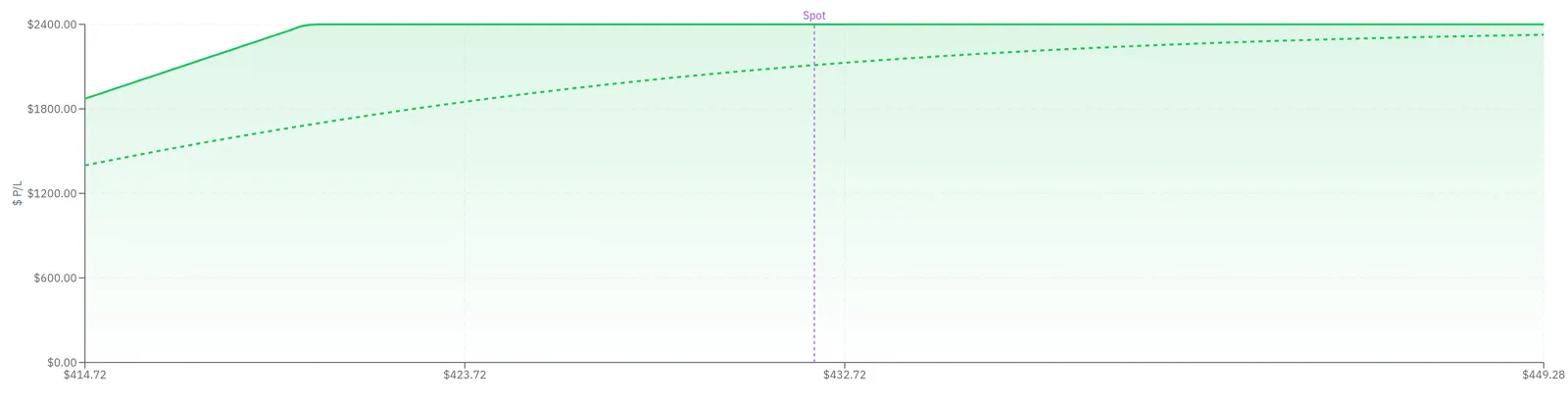
Then look at the whole position as a picture. This link opens the example in the Position Analyzer with the stock leg and the short call already filled in:
Run it on your own numbers: Open this MSFT example in the MetisTrades Position Analyzer and change the strike, expiration and prices to yours
In the screenshot below, look at the Profit / loss diagram. The solid curve is At expiration, and it goes flat above the strike. That flat line is your cap. The dashed curve is Today. Check the Payoff at expiration box too: Breakevens, Max profit and Max loss are for shares and call combined, not the option alone.
Now make it yours:
- Stock leg – In the rail, change the stock's entry value. Set it to your actual cost to see the whole trade. Set it to TODAY's price to run the "would I buy it now?" test, and the chart shows the position as if you'd just opened it.
- Option leg – Change the Strike, Expiration and Price (per share) to match your call.
- Model the roll – Edit the call leg to the new strike and expiration, with the new call's price. Compare Max profit and the breakevens to the version you started with.
- Model the buyback – Remove the option leg. What's left is just the shares.
- Price mode – Natural uses the ask when buying and the bid when selling, which is closer to a realistic fill than Mid.
- Range of prices – Switch from Graph to Table for the Profit / loss heatmap: rows are stock prices, columns are dates. That's your "what if it lands here?" view for every outcome at once.
If your covered call is already imported, you can skip the typing. On Open Positions, use Open in Position Analyzer. A covered call can bring its matching shares along so the payoff includes the stock. After you act, the Covered Calls page under Analysis tracks how it ended, with outcome badges like Assigned or Rolled, and a Chain Total for rolled trades.
The moral of the story…
The roll credit isn't the decision.
The tax bill isn't the decision.
The decision is whether you want to own the stock at today's price.
If not, let it go. If so, pick the version of owning it whose cap and cost you can live with.
Please, please, please rerun this with your own strikes and dates, and pick apart my spreadsheet if something looks off. Did framing it as "would I buy it today?" change how you'd handle your next in-the-money call?
Related guides and help pages
Related guides
- The stock blew past your covered call strike in a week: is buying the call back worth it?
- Your short put is deep in the money with a week left: take assignment, roll, or close?
- One leg of your credit spread was assigned early: the cleanup, step by step
- A gap blew through your short strangle: damage control without doubling down
- Earnings land before your short put expires: close, hold, or roll past the report?
- Assigned and 15% under water: where do you sell the first covered call?