Assigned and 15% under water: where do you sell the first covered call?
You got assigned at $100 and the stock is at $85. Selling a call at your basis pays pennies, and selling at the market can lock in a loss. Here is what each strike policy costs you and what it buys, on the same position.
You sold a put, got assigned 100 shares, and the stock has since dropped 15% below your strike. Now you have to sell the first covered call. A call at your cost basis pays almost nothing. A call near the market price pays real money, but it can sell your shares at a loss. This post prices both, plus a middle option and a "switch later" rule, so you can choose on purpose instead of by habit.
The situation
Let's say you sold a put on XOM at the $100 strike and collected $2.50 per share.
The stock dropped. You got assigned.
Assignment – the put buyer used their right to sell you shares, so you now own 100 shares at $100 each.
The $2.50 you collected up front still counts, so your net cost basis (ie. what the shares really cost you once the premium is subtracted) is $97.50 per share. That is the −$97.50 per share of net cash sitting in this trade.
And the stock? It's at $85. (Example prices for teaching, not a live quote.)
So you go to sell a covered call. A covered call – you sell someone the right to buy your shares at a fixed price, the strike, until a set date, and they pay you a premium for that right.
The 30-day calls are bidding:
- $0.45 at the $100 strike – the price you paid for the shares
- $1.90 at the $90 strike
- $3.40 at the $85 strike – at the money, ie. right at the current stock price
In your words, the question goes something like this: "If I sell at $100 I make 45 bucks a month and wait forever. If I sell at $85 I make real money, but if the stock bounces I just sold my shares for a loss. What the heck do I do?"
Anyone who runs the wheel ends up here sooner or later. (The wheel – sell puts until assigned, sell calls on the shares until they're called away, repeat.)
The reason it isn't obvious is that the two numbers that matter pull in opposite directions. Premium today goes UP as the strike comes down. The price you get if the shares are called away goes DOWN as the strike comes down.
Most advice turns this into a rule of conduct: "Never sell below basis!!" or "Just sell near the money and move on." That isn't wrong, exactly. It just skips the part where you look at what each choice actually does to your numbers…
The realistic choices
You've got four plain choices and one policy that mixes them. Let's go down the list.
1. Sell the 30-day $100 call (at the strike you paid)
What it buys – if the stock recovers all the way and the shares get called away, the whole trade finishes in the green.
What it gives up – almost all the premium. At $0.45 a share, you're chipping at the hole with a teeny-tiny spoon.
2. Sell the 30-day $90 call
What it buys – a premium more than four times bigger than the $100 call.
What it gives up – if the stock climbs back above $90 and you get called away, you sell below your $97.50 basis.
3. Sell the 30-day $85 call (at the money)
What it buys – the most premium on the menu.
What it gives up – the stock doesn't need to rally at all for you to get called away. It only has to finish above $85. Then you're out of the shares at a loss, with no chance to catch any recovery.
4. Sell no call yet
What it buys – full upside if the stock bounces, and time to let the dust settle after assignment (some traders like to wait a day or two).
What it gives up – any premium. And you still hold ALL the downside. Waiting doesn't protect you from anything.
5. The hybrid: start at basis, switch after N days
This one is a policy, not a single trade. You write the rule down before you start:
Sell calls at or above $97.50 for the first N days after assignment. If the shares are still mine after N days, move the strike toward the market price (say, the $90 or $85 row).
Days without a fill – for this post, that means calendar days counted from the assignment date during which your shares have not been called away. The clock doesn't reset because one call expired worthless.
What it buys – a stretch of time to see whether the stock recovers on its own, before you start accepting a below-basis exit.
What it gives up – the bigger premiums during those first N days. And if the stock rallies right AFTER you switch… sucks to be you, you're capped.
Not in this comparison
Selling the shares outright and walking away is a real choice too, so is rolling a call down once it's open, so is adding "repair" positions. They're worth their own guide. This one sticks to the first call.
The worked example
Here's every choice run through the same position: 100 shares, net basis $97.50, stock at $85, one contract each, 30 days.
| Choice | Cash today | Breakeven stock price | Capital tied up | Whole-trade worst case (stock to $0) | P/L if called away at that strike |
|---|---|---|---|---|---|
| Sell the 30-day $100 call | $45 | $97.05 | $8,500 | −$9,705 | $295 |
| Sell the 30-day $90 call | $190 | $95.60 | $8,500 | −$9,560 | −$560 |
| Sell the 30-day $85 call | $340 | $94.10 | $8,500 | −$9,410 | −$910 |
| Sell no call yet | $0 | $97.50 | $8,500 | −$9,750 | $0 (no call open) |
Let's run the arithmetic, one column at a time.
Cash today
Premium per share × 100 shares. ie. 0.45 × 100 = $45, 1.90 × 100 = $190, 3.40 × 100 = $340.
Breakeven stock price
Your net basis minus the new call premium.
Breakeven = net basis − call premium; ie. 97.50 − 0.45 = $97.05, 97.50 − 1.90 = $95.60, 97.50 − 3.40 = $94.10.
Each call lowers the price the stock needs to get back to. The $85 call lowers it the most.
Capital tied up
The shares are worth $85 each today, so $8,500 is tied up in every row. The call choice doesn't change that.
Whole-trade worst case
If the stock went to $0, you'd keep the premiums and lose the shares.
Worst case = (−97.50 + call premium) × 100; ie. (−97.50 + 0.45) × 100 = −$9,705.
The calls only shave a little off the disaster number. A covered call is NOT a hedge worth mentioning when the hole is this deep.
P/L if called away
This is the column people fight about. It counts EVERYTHING: the put premium, the call premium and the strike you sell at, against the $100 you paid.
Called-away P/L = (−97.50 + call premium + strike) × 100
- $100 call – (−97.50 + 0.45 + 100) × 100 = $295
- $90 call – (−97.50 + 1.90 + 90) × 100 = −$560
- $85 call – (−97.50 + 3.40 + 85) × 100 = −$910
Notice what that −$910 is. It's the result for the whole trade, with $2.50 of put premium and $3.40 of call premium already folded in. The share leg on its own (bought at $100, sold at $85) looks worse than that. When someone tells you "selling at $85 locks in a $15 loss," they're quoting the shares and ignoring the premiums.
What the table is telling you
Simply put, you're trading premium today against the price you exit at later.
The $100 call gets you the only positive called-away result, and pays $45 for the month.
The $85 call pays $340, and if the stock simply sits still and finishes above $85, you're out at −$910.
No call keeps every bit of upside and collects nothing.
The $90 call sits in between on both counts.
And the months-to-recover question?
Your gap is the distance between the $97.50 net basis and the $85 stock price.
Divide that gap by one month's premium and you get a rough count of months it takes to close it with premium alone. Run it with $0.45 and then with $3.40. The difference is MASSIVE. That's the real cost of the at-basis policy: time.
Of course, that division assumes the premium stays the same every month and the stock does nothing. It won't, on either count. Read it as a feel for the scale, not a schedule.
The hybrid is just two of these rows stitched together: $100-call months until day N, then $90 or $85 months after.
All of this is in a spreadsheet: one row per choice, with the formulas already filled in, so you can check every number above and add your own rows underneath.
Download the template: First covered call after assignment, stock 15% below the strike — choices compared (.xlsx). It opens in Excel, and in Google Sheets via File → Import. The worked example from this guide is already filled in, and the formulas carry down into the blank rows.
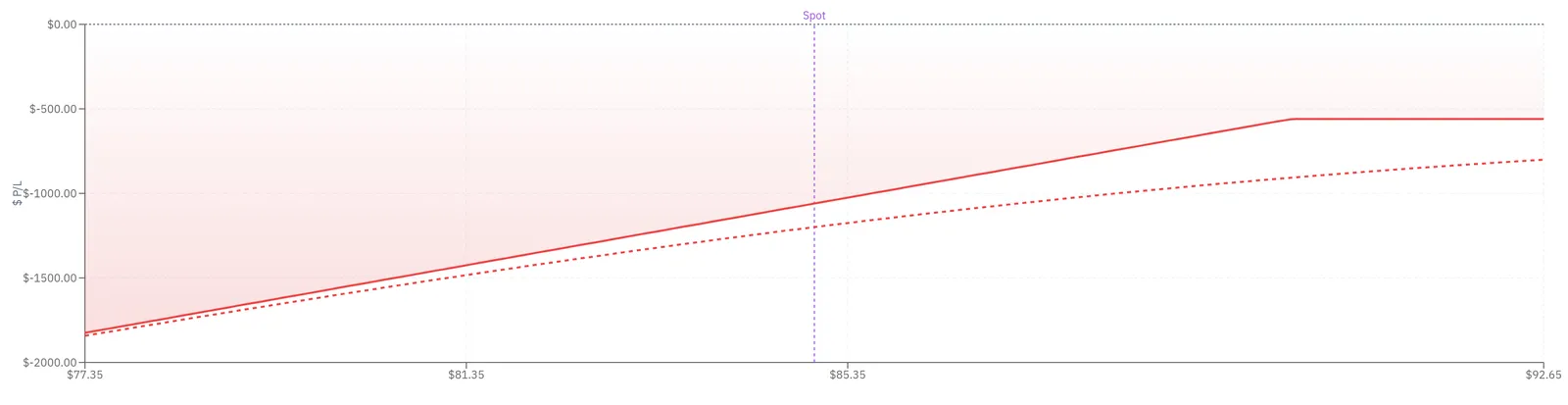
Here's the $90 row loaded into the Position Analyzer: the 100 shares at $97.50 plus the short $90 call. Look at the expiration curve going flat above the strike – that flat stretch is the capped upside. Then check the Breakevens line under Payoff at expiration against the $95.60 in the table.
The decision rule
"Just tell me which strike is right!!1!"
I can't. Nobody can. I don't know whether the stock goes back to $100, sits at $85, or keeps sliding, and neither does anyone else. What I can give you is a rule that matches the strike to what you actually want from the position.
The rule, as conditions
- If you'd honestly be happy holding these shares for a long time and only want out at a profit for the whole trade, then sell at or above your net basis (the $100 row) and accept the slow pace. You're paying for that $295 exit with months of small premiums.
- If you're fine being out at a modest whole-trade loss, and the −$560 is a number you've looked at and accepted, then the $90 row is a reasonable middle.
- If your reason for owning the stock is gone and you want out, then the $85 call is a way to get paid for leaving. (So is selling the shares today. Compare the two before you choose.)
- If you can't decide between the first two, then use the hybrid and WRITE DOWN N before you start. A switch date you make up halfway through is just a mood.
- If you want a day or two after assignment for things to settle, then waiting is fine, as long as you remember the "Sell no call yet" row: zero premium and all the downside.
Where your basis comes from
Use your TRUE net basis, not just this one put. If you rolled the put before assignment, the credits and debits from every roll belong in it. In MetisTrades, a wheel cycle's Put premium includes put-leg premium from every position in a put roll chain, and the Assign/Exercise page has an Include roll costs in P/L switch that swaps in the full roll-chain result. Using the wrong basis moves every row of the table.
Delta and DTE
DTE – days to expiration. Delta – roughly how much the option's price moves for a $1 move in the stock.
The Wheel Analyzer's covered-call phase defaults to 0.30 delta and 30 DTE. Those are starting settings for a simulation, not a recommendation. Underwater shares often push the at-basis strike far out of the money, which is exactly why it pays so little.
The honest limits
- The rule is about what you want, not where the stock goes. It can't tell you which row ends up best in hindsight.
- Premiums change every month. The table is one snapshot.
- Getting called away below basis and then buying the stock back could run into wash-sale rules on the tax side. MetisTrades' tax figures are estimates from imported transactions, not tax advice and not a substitute for your broker's 1099-B. Ask a tax pro about your own case.
- Options involve real risk. None of these rows protects you much if the stock keeps falling (look at that worst-case column again).
Run it on your own numbers
Three steps. Spreadsheet, Analyzer, then (if you want history) the Wheel Analyzer.
1. Add your rows to the spreadsheet
Put in your own net cash per share (put premium, plus or minus every roll), your current share price, and the bids you see at three or four strikes. The formulas give you breakeven, worst case and called-away P/L for each one.
2. Open the example in the Position Analyzer
This link opens the worked example with the shares and the $90 call already filled in:
Run it on your own numbers: Open this XOM example in the MetisTrades Position Analyzer and change the strike, expiration and prices to yours
Once it's open:
- Change the symbol to yours and select Load.
- Edit the stock leg's entry value to your net basis per share.
- Drag or edit the call's Strike to compare the at-basis, middle and at-the-money choices, and pick the Expiration you'd actually sell.
- Check the Price choice. Natural uses the bid for a short leg, which is closer to a conservative fill than Mid. Quotes are delayed, so treat every price as a reference, not a fill.
- Read Breakevens, Max profit and Max loss under Payoff at expiration. With shares plus a short call, the max-profit figure is the called-away result, and below basis it can be a negative number. Yes, really.
- Slide Days forward to see what the position looks like partway through the month.
3. Test the policies over many cycles
One month is one sample. To compare the three policies across a whole history, the Wheel Analyzer (Pro) has a Strike Selection Mode setting with exactly these choices: Above Cost Basis (Safe), Chase Price (Aggressive) and Hybrid (Time-based Switch). Choosing Hybrid adds Days Before Switch, which is your N. Look for that dropdown under the Covered Call (CC) Phase inputs.
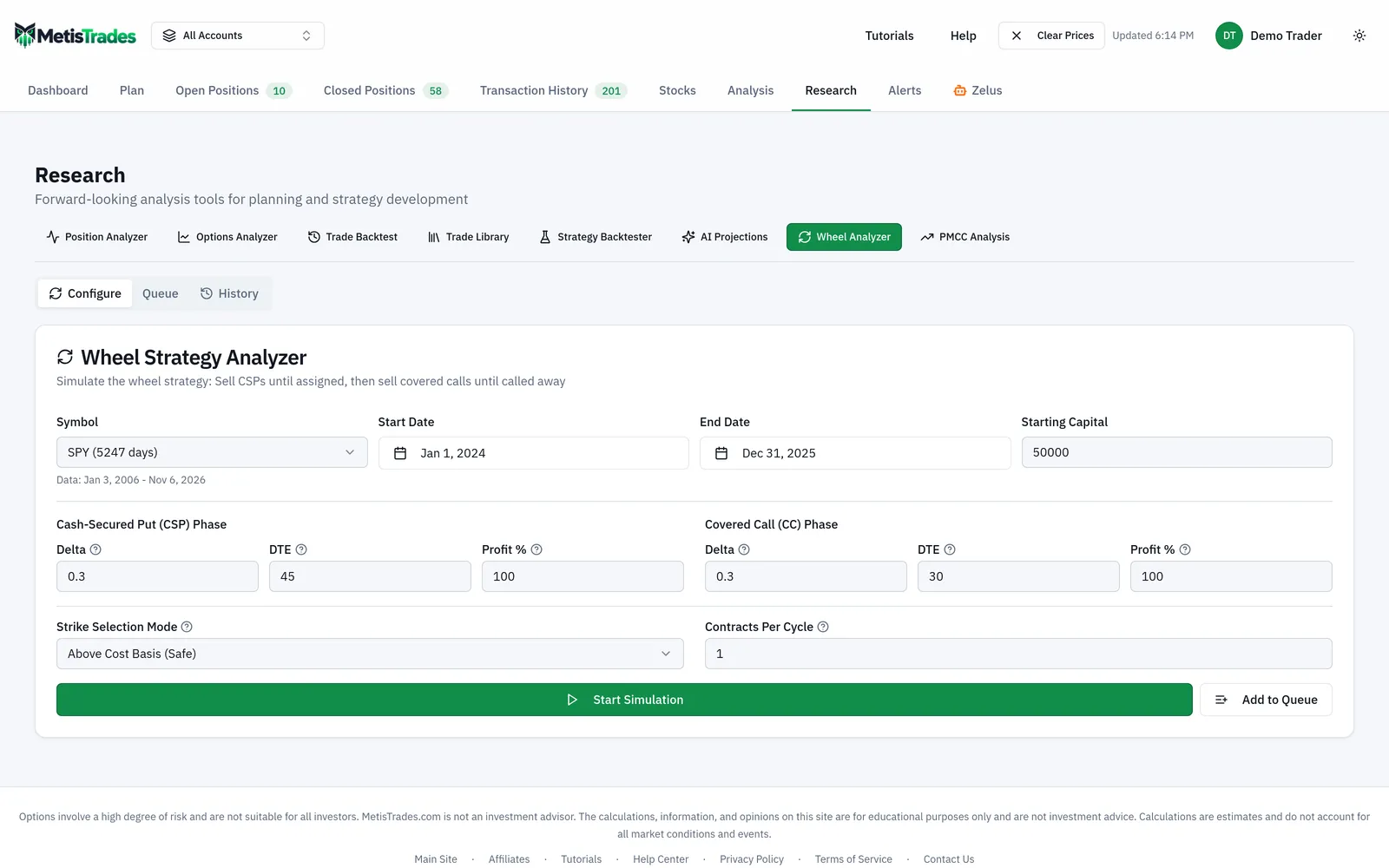
Run the same symbol and dates three times, changing only the strike mode. Then open History and compare Total P/L, CC Premium, Stock P/L, Max Drawdown and Completed Cycles. With two or more finished runs you can switch to Scatter and plot them side by side.
Our strike-mode data study on NVDA does this exact comparison. Be careful with it: it's ONE ticker over one stretch of history, with simulated fills. It tells you how the policies behaved there, not how they'll behave on your stock. The Wheel Analyzer says the same thing about its own results: they're historical simulations, not predictions.
Please, please, please rerun it on a different symbol or different dates and see whether the ranking holds up.
The moral of the story…
It's not "never sell below basis."
It's not "always chase the premium."
It's premium now against the price you leave at later, and you can put a number on both.
Write your N down before the stock starts messing with your head.
So: did pricing the choices this way make your own call easier, or is there a row you'd add to the table that I left out?
Try it in MetisTrades: Wheel Analyzer
Related guides and help pages
Related guides
- Assigned early on a covered call the day before ex-dividend: what happened and what to do now
- One leg of your credit spread was assigned early: the cleanup, step by step
- PMCC short call in the money: roll it, close both legs, or exercise the LEAPS?
- Your short put is deep in the money with a week left: take assignment, roll, or close?
- Covered call in the money before expiration: let the shares go, roll up and out, or buy it back?
- The stock blew past your covered call strike in a week: is buying the call back worth it?