Assigned early on a covered call the day before ex-dividend: what happened and what to do now
One of your in-the-money calls got assigned the day before ex-dividend, and the dividend went to someone else. Here is why, how to check for it next time, and four ways to handle the call that is still open.
You sold calls against your shares, they drifted in the money, and one morning 100 of your shares were gone, the day before the stock went ex-dividend. Nobody waited for expiration. This post covers why that happens, how to spot it coming, what your account looks like now, and what to do with the call that is still open.
The situation
Let's say you own 200 shares of KO, bought at $84.00. (KO at an illustrative $95.67 here. These are example prices, not a live quote.)
Twenty-five days ago, with the stock at $91.84, you sold two $90 calls for $3.41 each.
The stock went up.
Both calls went in the money (ie. the stock is above the strike, so the call has real exercise value).
Then, the day before ex-dividend, one of them got assigned.
100 shares left your account at $90.
The dividend on those shares went to whoever exercised.
The other call is still open, with 10 days left, now marked at $5.81.
So, the questions running through your head are probably:
- "Why now?! Expiration isn't for another week and a half!!"
- "Did I lose the dividend, or do I owe it?"
- "Can I undo this?"
- "What do I do with the second call?"
Let's go down the list.
Why the day before ex-dividend?
The ex-dividend date is the first day a buyer of the stock no longer gets the next dividend. To collect it, you have to own the shares going into that date.
The person who BOUGHT your call doesn't own shares. They own a right to buy shares at $90.
If they exercise on the last day before the ex-date, they own the shares in time and they get the dividend.
If they don't, they keep the call and the dividend goes to you.
So, they're weighing two things:
- Extrinsic value – the part of the call's price above its intrinsic value (intrinsic = stock price minus strike, for an in-the-money call). It's what they throw away by exercising instead of selling the call.
- The dividend – what they pick up by exercising.
If the dividend is bigger than the extrinsic value left in the call, exercising is the better deal for them. Simply put, the leftover time value is cheaper than the dividend.
That's the whole thing.
It's not personal. It's arithmetic.
Why it's not obvious
Most covered-call sellers think about assignment as an expiration-day thing. And most of the time, it is.
But American-style equity options can be exercised any day. The dividend is the one moment in the calendar where an early exercise regularly makes sense for the holder. And deep in-the-money calls close to expiration have almost no extrinsic value left (look at your remaining $90 call: it's marked at $5.81 with the stock at $95.67, so nearly all of that price is intrinsic, and what's left over is teeny-tiny).
Not to mention, the exercise happens overnight. You find out on ex-date morning, after the dividend is already spoken for. There's no window to react.
The realistic choices
First, the call that already got assigned.
There's nothing to fix there.
Your shares were delivered at $90.
You keep the $3.41 premium from that call.
The dividend on those 100 shares went to the exerciser.
"But, but, but! Can I get the dividend back?!"
No. The exercise was valid, the holder owned the shares going into the ex-date, and the dividend belongs to them. Assignments aren't reversible. Sucks, but that's the deal you signed up for when you sold the call.
Covered vs uncovered: did you lose it or owe it?
This matters a TON, so let's be clear:
- Covered (you held the shares) – the shares left, you got the strike price in cash, and you simply don't receive the dividend. You lost it. You don't owe it.
- Uncovered, or the short leg of a spread (no shares behind it) – assignment makes you short 100 shares over the ex-date. A short seller owes the dividend to the lender, so your broker debits a payment in lieu (ie. a cash charge equal to the dividend per share × 100).
"What if I buy the shares back first thing on ex-date morning?"
Doesn't help. You were already short when the ex-date arrived. Covering on ex-date morning closes the short, but the dividend debit stays. Kinda harsh, but that's the timing.
If it was a spread with your long call still open, you have more tools: you can exercise your long call to deliver the shares, or buy shares and sell the long call separately. Exercising the long call throws away whatever extrinsic value it had left, so selling it is often worth comparing first. Either way, the dividend debit doesn't go away.
The rest of this post sticks with the covered case: your second $90 call is still open, against your remaining 100 shares.
Choice 1 – Do nothing
Let the remaining call ride. If KO is above $90 at expiration, it gets assigned and the other 100 shares go at $90.
Gives up: anything the stock does above $90.
Buys: no new trade, no new cost. Cash today: $0.00.
Choice 2 – Buy the remaining call back and keep the shares
Pay $5.81 per share to close the call. That's a $581.00 debit.
Gives up: $581.00 of cash today.
Buys: you keep the shares, the upside, and any future dividends. You also keep the full downside of owning stock.
Choice 3 – Roll up and out
Buy back the $90 call and sell the 38-day $99 call at $1.19. Net, that's a $462.00 debit.
Gives up: $462.00 today, and you're still short a call, just a higher, longer-dated one.
Buys: room for the stock to run to $99 before your shares get called. And whether the new call sits past the next ex-date is exactly the thing to check (more on that below).
Choice 4 – Close the whole position
Buy back the call and sell the remaining 100 shares at $95.67. Net credit: $8986.00.
Gives up: any further gain on KO.
Buys: you're done. No assignment risk, no stock risk, nothing open.
The worked example
Everything below comes from a spreadsheet that runs each choice through the same formula: cash so far, plus cash today, plus the shares and any open option valued at the stock price you pick at expiration. It already has this example and its formulas, so you can check every line and change the price yourself.
Download the template: Covered calls in the money, one assigned early the day before ex-dividend — choices compared (.xlsx). It opens in Excel, and in Google Sheets via File → Import. The worked example from this guide is already filled in, and the formulas carry down into the blank rows.
Net cash before today is −$7118.00 for the whole position. That's the shares you bought, plus the premium from both calls, plus the cash that came in when 100 shares were delivered at $90. Every row starts from that same number.
| Choice | Cash today | Shares after | Open option | P/L at expiration, stock at $95.67 | P/L if stock goes to $0 | Best case at expiration |
|---|---|---|---|---|---|---|
| Do nothing, assigned at $90 | $0.00 | 100 | Short 1 $90 call | $1882 | −$7118 | $1882 |
| Buy back call, keep shares | −$581.00 | 100 | None | $1868 | −$7699 | Unlimited |
| Roll to 38-day $99 call | −$462.00 | 100 | Short 1 $99 call | $1987 | −$7580 | $2320 |
| Close everything today | +$8986.00 | 0 | None | $1868 | $1868 | $1868 |
Formula behind each P/L cell: P/L = net cash before today + cash today + shares × price + the open option's value at that price. Read the close-everything row: −$7118 + $8986 = $1868, and nothing is left to move, so every column says $1868.
Let's run the rows.
- Do nothing – $1882 if KO is at $95.67 at expiration, because the shares go at $90 and you keep the premium. That's also the best it gets ($1882 is the cap). If KO went to $0, you'd be at −$7118. Meh, a stock going to zero is extreme, but it shows you still hold the stock risk.
- Buy back – $1868 at $95.67. The best case says Unlimited, ie. no cap on the upside, since nothing is short anymore. But the floor drops to −$7699, because you spent $581.00 to get there.
- Roll – $1987 at $95.67, the highest of the four at today's price. Capped at $2320 if KO finishes at or above $99. Floor of −$7580.
- Close – $1868 no matter what. No upside, no downside.
What the table does NOT say:
It doesn't say which row is best. Each number assumes the stock sits at one price on expiration day. Change that price and the order shuffles. I don't know where KO goes from here, and neither does anyone else.
Notice the buy-back and close rows land on the same $1868 at $95.67. Of course they do: at that price, holding the shares is worth exactly what selling them today brings in. The difference is only what happens if the price moves.
Now, the ledger side. Once your broker history is imported, the early assignment shows up in MetisTrades under Analysis → Assign/Exercise. Look for the KO row, expand it, and you'll see the event with a Call Assigned badge, the Strike, the FIFO Cost Basis of the shares that left, the Shares count, the Date, the Premium from that call, and the Stock P/L from the delivery.
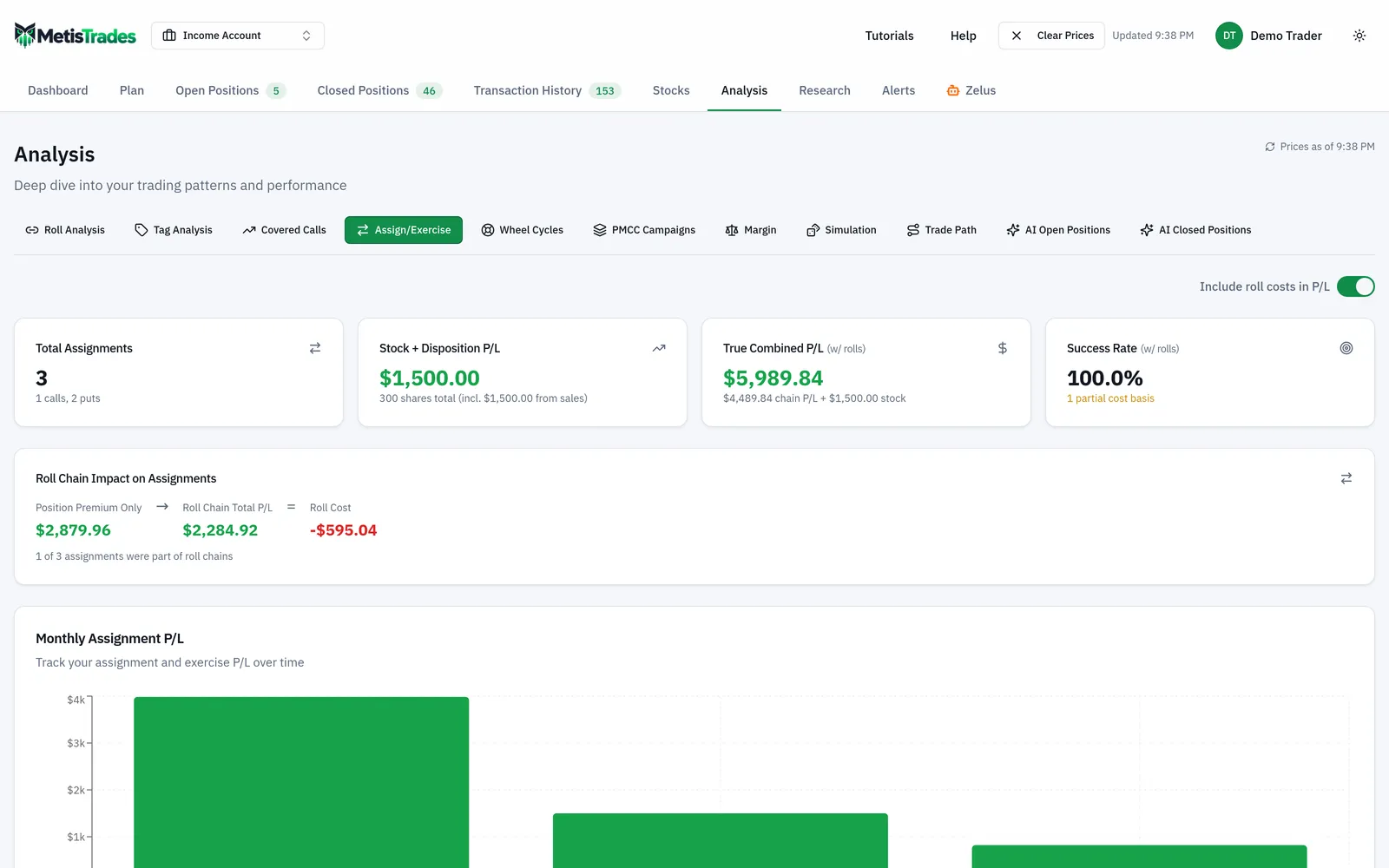
What you WON'T see there is a dividend for those 100 shares, because you never received one. If you were in the uncovered case, the payment-in-lieu charge is a line on your broker statement; check it there.
The P/L figures on that page are estimates from your imported transactions. Your broker's official forms are the record for tax purposes.
The decision rule
Before the next ex-date: the check
This is the part that would have flagged the first call.
The day before the ex-date, for each short call you have open:
- Get the call's price (the mid of bid and ask is fine).
- Work out intrinsic value: stock price minus strike. If that's zero or negative, the call is out of the money and the dividend check doesn't apply.
- Extrinsic = call price − intrinsic.
- Compare extrinsic to the declared dividend per share.
The rule:
- If the call is in the money AND the dividend is bigger than the extrinsic value, then early assignment is likely. Plan for it.
- If the extrinsic value is comfortably bigger than the dividend, then early assignment is less likely, but not impossible.
- If the two numbers are close, then treat it as a coin you don't control.
"But Schwab says to use the put!!"
Fair point. A stricter version of the check compares the dividend to the extrinsic value of the put at the same strike and expiration. The idea is that a sophisticated holder can exercise the call and buy that put to hedge, so the put's time value is what they're really giving up. The call's extrinsic is the simple version; the put's is the tighter one. If both say "at risk," believe it.
The honest limits
The rule says "likely," not "certain."
People exercise when the numbers don't quite justify it. They have different costs than you. Some do it by mistake.
And you can't tell in advance whether YOUR contract gets picked. Exercises are allocated to brokers, and then the broker assigns them across its customers' short contracts by its own method. You might hold an at-risk call and get skipped. You might hold a borderline one and get hit.
Choosing between the four
- If you're fine selling the remaining shares at $90, then doing nothing is a real choice. It costs $0.00 today and caps you at $1882.
- If you want to keep the shares (and future dividends) no matter what, then buying back is the only choice that removes the cap and the assignment risk. It costs $581.00 and takes the floor down to −$7699.
- If you want to keep selling calls, then roll, and run the check above on the new call against the next ex-date. The $99 call costs $462.00 net and caps you at $2320.
- If you just want this over, then close it. $8986.00 in today, $1868 locked in.
None of those is the right answer in general. They're different bets on a stock that nobody can forecast. The point is to pick one on purpose instead of waking up to it.
Run it on your own numbers
The link below opens this example in the Position Analyzer with the legs already filled in: the short $90 call and the 100 shares.
Run it on your own numbers: Open this KO example in the MetisTrades Position Analyzer and change the strike, expiration and prices to yours
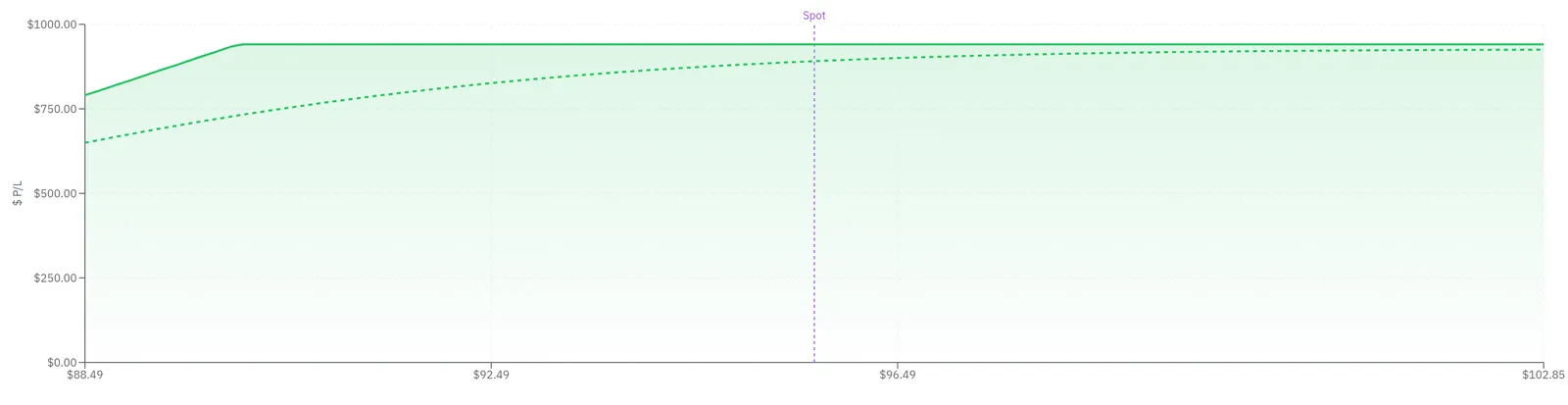
Once it's open, check the Payoff at expiration numbers (Net debit/credit, Breakevens, Max profit, Max loss) and the curve against the price axis. The solid line is expiration; the dashed line is today.
Then make it yours:
- Load your own ticker in Symbol.
- On the option leg, change Strike, Expiration, Quantity and Price (per share) to match your call. The leg shows Bid, Mid and Ask when quote details are available, which is everything you need for the extrinsic check above.
- On the stock leg, set Shares and the entry value to what you actually paid.
- To test the roll, change the call's strike and expiration to the one you're considering and compare the payoff.
- Move Days forward to see what the position looks like on the day before the next ex-date.
Quotes in the analyzer are delayed, so treat the prices as a starting point, not a fill.
And then, please, please, please open the spreadsheet and add your own rows. Change the stock price at expiration. Try a price below $90. Try one above $99. Watch which row wins and which row hurts. Critique my numbers while you're at it.
The moral of the story…
Early assignment before ex-dividend isn't random.
It's not your broker messing with you.
It's not bad luck.
It's a dividend that was worth more than the time value left in your call.
You can check for it the day before.
You can't undo it the day after.
Did this clear up what happened to your shares? And would a strike-by-strike version of the check, run on your own chain, be useful to see next?
Try it in MetisTrades: Analysis → Assignments
Related guides and help pages
Related guides
- One leg of your credit spread was assigned early: the cleanup, step by step
- PMCC short call in the money: roll it, close both legs, or exercise the LEAPS?
- Assigned and 15% under water: where do you sell the first covered call?
- A gap blew through your short strangle: damage control without doubling down
- Short option at 80% profit with weeks left: close it and redeploy, or wait?
- Your short put is deep in the money with a week left: take assignment, roll, or close?