The stock blew past your covered call strike in a week: is buying the call back worth it?
Your stock jumped through your covered call strike and you want the upside back. The missed gain is sunk. Here is how to price buying back, rolling, closing or doing nothing as a fresh decision.
You sold a covered call, the stock jumped about 12% on news a week later, and now you are staring at a short call that is deep in the money with three weeks left. You want the upside back. This post answers one question: is paying to close that call worth it from here, compared with rolling, closing everything, or doing nothing?
The situation
Let's say you own 100 shares of AAPL, bought at $301.00.
Seven days ago, with the stock at $304.71, you sold one $320 call for $3.71. That left you with net cash of −$297.29 per share ($3.71 in, $301.00 out).
Then the news hit.
In these example prices (illustrative, not a live quote), AAPL is now $342.37. Your $320 call has 21 days left and marks at $25.73.
And the question in your head sounds something like this:
"I sold away all that upside for $3.71?! Can I buy the call back and get it back?!"
The thing is, two very different questions are tangled together in there…
Question one – "Did I miss a gain?" Yes. The stock ran above $320 and that part belongs to whoever bought your call. That already happened.
Question two – "Should I pay $25.73 per share today to change what happens over the next 21 days?" That one is still open.
Only the second question has an answer you can act on.
The missed gain is a sunk cost. No trade you place today reaches back in time and un-sells that call at $3.71. Buying back doesn't "recover" anything. It's a brand-new purchase, at today's price, with its own payoff.
Why is this not obvious? Because the buy-back FEELS like undoing a mistake. It isn't. It's a fresh bet that the stock keeps going up, and it has a price tag.
What's inside that $25.73
An option's price has two pieces:
- Intrinsic value – what the call would be worth if exercised right now; ie. the stock price minus the strike (here, $342.37 minus $320).
- Extrinsic value (aka time value) – everything above intrinsic. It reflects time left, implied volatility and supply and demand, and it usually decays toward zero by expiration.
Here's the key part.
The intrinsic piece isn't really a "cost" of buying back. You'd give that up either way, either by paying it to close or by selling your shares at $320 instead of $342.37.
The extrinsic piece is the actual price of the decision. That's what you pay for the right to keep your upside for 21 more days.
The realistic choices
Let's go down the list. Four choices are actually on the table here, and "do nothing" is a real one.
1. Do nothing and let the shares be called away at $320
No cash changes hands today. If the stock is still above $320 at expiration, your shares get called away and you receive $320 per share.
What it gives up – any rise above $320 between now and expiration.
What it buys – you keep the call's remaining time value instead of paying it. You pay nothing to anyone.
One wrinkle: if the stock drops back below $320 by expiration, the shares are NOT called. You keep them, plus the premium, at whatever price the stock is then.
2. Buy the call back and keep the shares
You pay $25.73 per share to close the call. You're back to owning plain shares with no cap.
What it gives up – the time value inside that $25.73, paid today, for sure.
What it buys – every dollar of upside from here, and every dollar of downside from here too. You're now simply long 100 shares at $342.37.
3. Roll up and out to the 48-day $360 call
You buy back the $320 call at $25.73 and sell the 48-day $360 call at $5.95. Net debit: $19.78 per share.
What it gives up – some cash today, 27 more days of being capped, and your upside above $360.
What it buys – a higher cap ($360 instead of $320) and a new premium that offsets part of the buy-back.
Be careful with this one. A roll is two trades stapled together: a buy-back plus a brand-new covered call. It doesn't make the first trade "work". It just starts a second one.
4. Close everything now and take the gain
Buy back the call at $25.73 and sell the shares at $342.37. Net credit: $316.64 per share.
What it gives up – the time value you'd have kept by waiting, plus any further move in either direction.
What it buys – you're done today. No position, no exposure, no waiting.
The worked example
Same position, same prices, four choices. Here's how they line up, per contract (100 shares). The spreadsheet behind this table has every row and formula, so you can poke at it:
Download the template: Covered call in the money after a sudden jump, three weeks left — choices compared (.xlsx). It opens in Excel, and in Google Sheets via File → Import. The worked example from this guide is already filled in, and the formulas carry down into the blank rows.
| Choice | Cash today | Breakeven stock price | Capital tied up | Locked-in P/L if you end flat | Worst case (stock to $0) | P/L if called at new strike |
|---|---|---|---|---|---|---|
| Do nothing, called away at $320 | $0 | none open | $0 | $2,271 | $2,271 | none |
| Buy the call back, keep the shares | −$2,573 | $323.02 | $34,237 | none | −$32,302 | none |
| Roll to the 48-day $360 call | −$1,978 | $317.07 | $34,237 | none | −$31,707 | $4,293 |
| Close everything now | $31,664 | none open | $0 | $1,935 | $1,935 | none |
Let's run the arithmetic, row by row.
Do nothing. You've netted −$297.29 per share so far. At expiration you receive $320. Locked-in P/L = (−297.29 + 0 + 320) × 100; ie. $2,271. That assumes the stock stays above $320 and the shares are called.
Buy back. Breakeven = what you've paid in, net. 297.29 + 25.73 = $323.02 per share. Cash out today is $25.73 × 100 = $2,573. Your capital is now the shares at today's price, $342.37 × 100 = $34,237. Worst case (the stock goes to zero, which is a stress test, not a forecast) is −$32,302.
Roll. Breakeven = 297.29 + 19.78 = $317.07. If the stock ends above $360 and you're called there: (−297.29 − 19.78 + 360) × 100 = $4,293. Worst case is −$31,707.
Close everything. (−297.29 + 316.64) × 100 = $1,935, banked today.
What the table is really saying
Look at the two "done" rows: $2,271 for doing nothing versus $1,935 for closing today.
Same shares. Same call. Same end state (no position).
The gap between those two numbers is EXACTLY the call's extrinsic value, times 100. That's the time value you hand back if you close today instead of waiting.
And that same gap is the hurdle for the buy-back.
Simply put: compared with letting the shares go at $320, buying back only comes out ahead if the stock rises further from $342.37 by more than the extrinsic value you paid (plus commissions, and whatever tax difference applies to you). If the stock just sits at $342.37, you paid for time that didn't do anything.
"But, but, but! The breakeven says $323.02, and the stock is way above that!!"
Right. And that's the trap. The $323.02 breakeven is for the WHOLE trade since you bought the shares. It tells you whether you're up overall. It does not tell you whether the buy-back beats doing nothing. For that, the bar is "today's price plus the time value", not $323.02.
Same story for the roll. Its $4,293 best case looks shiny next to $2,271, but it only shows up if the stock ends above $360 in 48 days. Below that, you're holding shares worth $34,237 of capital with a worst case of −$31,707. Different trade, different risk.
Is the required move plausible? Ask the option itself
So how far does the stock "usually" move in 21 days? Nobody knows where it goes. I sure don't.
But the option market publishes its own guess at the size of the move (not the direction) through implied volatility. A common rough version of the one-standard-deviation move to expiration:
Implied move ≈ stock price × IV × √(days left / 365)
Plug in $342.37, the call's current IV and 21 days. Then put the extrinsic value next to it. If the time value you'd pay is a small slice of that implied move, the hurdle is modest by the market's own pricing. If it's a big slice, you're paying for a move the market itself thinks is a stretch.
Neither answer tells you what happens next. It just tells you whether your hurdle is cheap or expensive, relative to what's priced in.
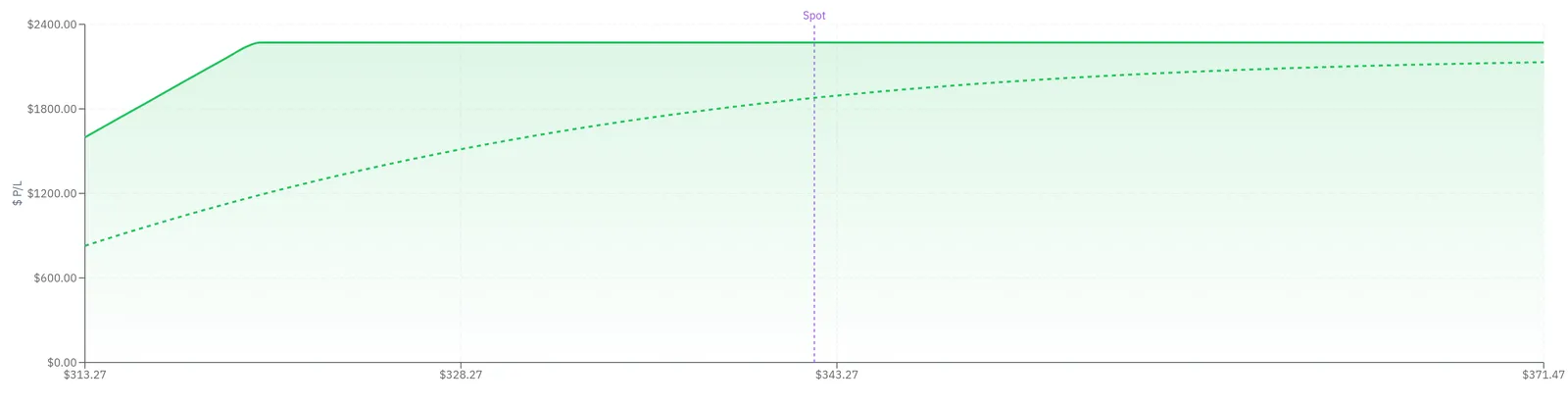
Here's the position in the Position Analyzer. Look at the gap between the dashed Today curve and the solid At expiration curve near the $342.37 spot price, which is the time value still left in the call:
Taxes, early assignment and dividends (the short version)
- Taxes – buying back realizes a loss on the call. Getting called away realizes a gain on the shares, with the premium folded in. Those can land very differently on your return depending on holding periods. Talk to a tax pro; this isn't tax advice.
- Wash sales – if you close at a loss and open something "substantially identical" within the window, the loss can be deferred. Whether a roll counts is a question for your tax pro. MetisTrades does not make wash-sale adjustments, and its tax figures are estimates from imported transactions, never a substitute for your broker's 1099-B.
- Early assignment – a deep in-the-money call with little time value left can be assigned before expiration, especially right before an ex-dividend date when the dividend is bigger than the remaining time value. If that happens, you're simply in the "do nothing" outcome early.
The decision rule
The point is, the question is never "how do I get the missed gain back?" It's "which of these four forward payoffs do I want, at today's prices?"
So:
- If you'd be fine selling at $320 (you said so when you sold the call) then doing nothing is a legit choice. You keep the time value and pocket $2,271 if the shares get called.
- If you want out today and don't care to wait 21 days then closing everything banks $1,935. The difference from $2,271 is the price of leaving early.
- If you'd happily BUY these shares today at $342.37, plus pay the call's time value, then the buy-back is consistent. If you wouldn't buy them fresh at that price, the buy-back is really just regret with a price tag.
- If the extrinsic value you'd pay is a big chunk of the implied move left then you're paying up for a move the market already thinks is a reach. If it's small, the hurdle is lower, but still not a promise.
- If you're rolling then judge it as a brand-new 48-day covered call at $360. Would you sell that call on shares you just bought at $342.37? If yes, fine. If you're only rolling to avoid "taking the loss", that's the sunk cost talking.
The honest limits of this rule:
It doesn't know where the stock goes. Nobody does.
The implied move is a market estimate, not a forecast, and it says nothing about direction.
Prices here are illustrative and delayed. Your fill on a deep in-the-money call can be worse than the mark, which raises the hurdle.
And taxes can flip the ranking entirely for your situation. Check that before anything else.
Run it on your own numbers
Please, please, please don't trust my example prices for your trade. Swap in your own.
The link below opens this exact position in the Position Analyzer with the short $320 call and the 100-share stock leg already filled in:
Run it on your own numbers: Open this AAPL example in the MetisTrades Position Analyzer and change the strike, expiration and prices to yours
Once it's open:
- Load your symbol and set the stock leg's entry value to what you paid for your shares.
- Edit the short call – set your strike, expiration and the price you sold it for.
- Read the call's current price from the Bid, Mid and Ask shown on the leg. Split it in your head: stock price minus strike is intrinsic; the rest is the time value you'd pay to close. Switch Price between Mid and Natural to see how much a worse fill moves things.
- Check the IV on the leg (or turn on the IV column in Table view) and run the implied-move formula above with your price and days left.
- Use Days forward to slide toward expiration and watch the dashed curve collapse onto the solid one. That collapse is the time value you'd keep by doing nothing.
- Model the roll by changing the call's strike and expiration to the one you'd roll into, then compare Breakevens and Max profit under Payoff at expiration.
- Try IV adjustment to see how the buy-back price would shift if volatility drops after the news fades. (I don't know if it will. Neither does anyone else.)
If the position is already in your imported portfolio, you can also use Open in Position Analyzer from the Analyze column on Open Positions; a covered call can come with its matching shares. And if you do buy back or roll, the Covered Calls page counts what you paid to close in Net Premium Income and marks rolled trades as Rolled, with a Chain Total across the chain, so your records show the full cost instead of just the shiny original premium.
Then fill in the spreadsheet with your figures and add your own rows. Critique my numbers. Rerun it with different strikes. Tell me where the logic breaks.
The moral of the story…
The missed gain is gone.
It's not a debt. It's not something a buy-back repays.
The only live question is whether the time value you'd pay today is worth the move you'd need from here.
So, when you ran your own position through this, was the hurdle bigger or smaller than you expected?
Related guides and help pages
Related guides
- Earnings land before your short put expires: close, hold, or roll past the report?
- Covered call in the money before expiration: let the shares go, roll up and out, or buy it back?
- Your short put is deep in the money with a week left: take assignment, roll, or close?
- One leg of your credit spread was assigned early: the cleanup, step by step
- A gap blew through your short strangle: damage control without doubling down
- Assigned and 15% under water: where do you sell the first covered call?