How Strategies Get Their Names (And How to Correct Them)
A position's strategy name is read from its legs — type, direction, strike, expiration and quantity — plus the shares you held at entry. Work through a covered call on XYZ by hand, then see where the label appears in MetisTrades and how to correct it.
What it is and why it matters
Every options position has a shape. That shape is made of legs — the individual stock or option parts of the position, each with its own side (buy or sell), quantity, strike, expiration and entry price. A strategy name is simply a shorthand for a recognised shape: "cash-secured put", "call credit spread", "iron condor".
Two terms you need before going further. The strike is the fixed price at which a call holder may buy, or a put holder may sell, the underlying. The contract multiplier (or contract size) is how many shares one contract represents — usually 100 for a standard equity option, and 10 for a mini option. The multiplier is what turns a price quoted per share into dollars.
Most of the time a name can be read straight off the legs. A single sell-to-open put is a cash-secured put. Two calls of the same expiration, one bought and one sold at different strikes, is a call spread. But some names depend on something outside the option itself: the shares you already own. A written call is a short call if nothing backs it, and a covered call if you hold enough shares to deliver on assignment. Same contract, same premium, very different risk — an uncovered short call has no defined ceiling on loss, while a covered call's shares are the thing that gets sold.
This matters for record keeping because the name drives what else gets measured. Break-even on a covered call is reduced by the premium you took in; break-even on a bare short call is a different calculation entirely. If your records call a position the wrong thing, every downstream summary built on that name inherits the error.
In MetisTrades, this naming is called strategy classification: the label the app gives a position after examining its opening legs, and for some single-leg options, the shares held in the same underlying when the option was opened. Where the imported history does not give the classifier enough context, you can apply an override — a saved correction to the displayed label that leaves the broker transactions untouched.
Work it out by hand
Take one position on a fictional ticker, XYZ, and name it yourself before any software does.
Step 1: list the legs
On 12 March you bought 300 shares of XYZ at $42.00. On 1 April you sold to open 2 XYZ call contracts, strike $50.00, expiring 16 May, for $1.20 each. Standard equity options, so the multiplier is 100.
| Item | Detail | Figure |
|---|---|---|
| Stock leg | Buy 300 XYZ shares at $42.00 on 12 March | $12,600.00 cost |
| Option leg | Sell to open 2 XYZ 16 May $50 calls at $1.20 on 1 April | $240.00 credit |
| Contract multiplier | Standard equity option | 100 |
| Shares required to cover | 2 contracts × 100 | 200 |
| Shares held at entry | Held since 12 March | 300 |
| Coverage test | 300 held vs 200 required | Covered |
| Name | Short call backed by sufficient shares | Covered Call |
| Premium per covered share | $240.00 ÷ 200 shares | $1.20 |
| Break-even on covered shares | $42.00 − $1.20 | $40.80 |
| Effective sale price if assigned | $50.00 + $1.20 | $51.20 |
| Profit on 200 shares if assigned | ($51.20 − $42.00) × 200 | $1,840.00 |
Step 2: turn the quoted price into dollars
The call was sold at $1.20. That is $1.20 per share, not per contract. Multiply by the multiplier and the quantity: $1.20 × 100 × 2 = $240.00 collected. If you skip the multiplier you will record $2.40 and be wrong by a factor of 100.
Step 3: run the coverage test
The question that decides the name is arithmetic, not opinion: do you hold at least as many shares as the calls could require you to deliver? Each contract covers 100 shares, so 2 contracts require 2 × 100 = 200 shares. You held 300 at the time the calls were sold. 300 ≥ 200, so the calls are covered. The 100 spare shares are simply unencumbered stock; they do not change the name.
Step 4: apply the name's arithmetic
Because the position is a covered call, the premium reduces your break-even on the shares that back it. Spread the $240 over the 200 covered shares: $240.00 ÷ 200 = $1.20 per share. Your purchase price was $42.00, so the break-even on those shares drops to $42.00 − $1.20 = $40.80. Below $40.80 at expiration, with the call expiring worthless, the combined position is underwater.
Now the upside. If XYZ finishes above $50.00 and the calls are assigned, you sell 200 shares at the strike: 200 × $50.00 = $10,000.00. Add the $240.00 premium you keep and the total received is $10,240.00, which is $51.20 per share. Those shares cost 200 × $42.00 = $8,400.00, so the gain is $10,240.00 − $8,400.00 = $1,840.00, or $9.20 per share — $8.00 from the strike being above your cost, plus $1.20 of premium. Anything XYZ does above $51.20 is upside you gave away in exchange for the $240.
Step 5: check what the name would be if coverage failed
Suppose your records only show 100 shares on 1 April, because the other 200 were transferred in from another broker and never recorded. Now the test reads 100 ≥ 200, which is false. The same two contracts are a short call, and none of the break-even arithmetic above applies — there is no $40.80 and no capped sale at $51.20, just an open obligation. The contracts did not change. The record did.
What changes the outcome
Change one number at a time in the example above and watch the name, or the dollars, move.
- Quantity. Sell 4 contracts instead of 2 against the same 300 shares. Required coverage becomes 4 × 100 = 400 shares; 300 < 400, so the position is no longer sufficiently backed for a covered-call label. Credit rises to $1.20 × 100 × 4 = $480.00, but the shape has changed.
- Contract multiplier. Keep 2 contracts but make them mini options with a multiplier of 10. Coverage needed falls to 2 × 10 = 20 shares, and the credit falls to $1.20 × 10 × 2 = $24.00. Same quoted price, one-tenth the dollars.
- Direction. Buy the 2 XYZ $50 calls instead of selling them. You pay $240.00 rather than collect it, and the single buy-to-open call is a long call, not a covered call — owning shares alongside it does not make it one.
- Expiration. Buy a single XYZ call expiring 400 days after entry instead of 45 days. A long call whose expiration is more than 365 days after its entry date is labelled LEAPS. Move that expiration back to 360 days and it is a long call again.
- Option type. Sell 2 XYZ $40 puts instead of the calls. A single sell-to-open put is normally a cash-secured put; shares you own are irrelevant to that label. Buy puts instead, with genuine long shares behind them, and the shape is a protective put.
- Adding a leg. Keep the 2 short $50 calls and buy 2 XYZ $55 calls at $0.40 in the same expiration. Net credit is ($1.20 − $0.40) × 100 × 2 = $160.00, and two calls of the same expiration at different strikes, one bought and one sold, form a call credit spread. The owned shares no longer decide the name; the second option leg does.
- Strike and expiration together. Pair a sold near-dated $50 call with a bought far-dated $50 call and the shape is a calendar spread — same type, same strike, different expirations, opposite directions. Move the long leg's strike to $55 and the same pair becomes a diagonal spread.
- Fees. Charge $1.30 of fees on the opening fill and your net credit is $240.00 − $1.30 = $238.70, and break-even on the covered shares becomes $42.00 − ($238.70 ÷ 200) = $40.81 (rounded). Fees move the dollars. They do not move the label, because the label is read from type, direction, strike, expiration, quantity and share context.
- Missing history. Nothing about the trade changes, but your import begins after the share purchase. Coverage reads 0 shares, and a covered call is recorded as a short call. This is a common reason a correct trade carries the wrong name.
Where you see it in MetisTrades
The position tables that expose strategy classification and the correction flow are Pro surfaces; you need an active subscription or lifetime access to reach them through the normal signed-in app. Quotes used for open-position market values are delayed, so the dollar figures beside a label can differ from an executable price.
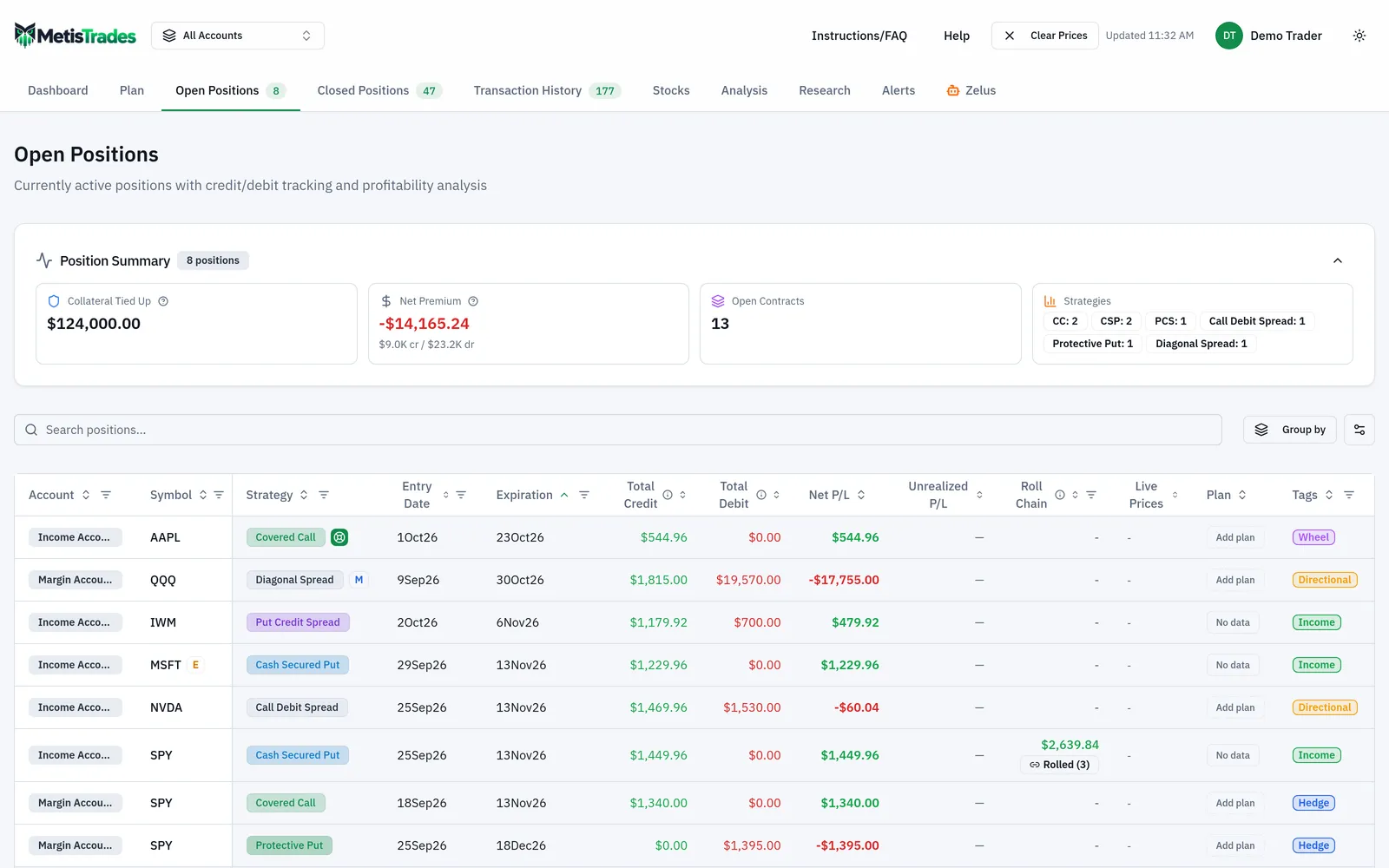
Start on Open Positions. The Strategy column holds the effective strategy for each row — the override when one exists, otherwise the automatic classification read from the opening legs. For the XYZ example you would expect to see Covered Call on the two-contract row, and the stock-backed treatment that goes with it, including the premium-based break-even reduction you worked out as $40.80. A row whose label has been overridden carries an R badge beside the strategy.
If the label is wrong because of missing share history, use Reclassify on Open Positions or Closed Positions. The Strategy Reclassification dialog opens on the Reclassify tab and lists eligible positions without an override. Only two conversions are supported: Short Call to Covered Call, and Long Put to Protective Put. Each row shows the original and target strategy, symbol, strike, expiration, entry date and P/L, so you can match the row against your own notes before changing anything. Use Search by symbol... to narrow the list, then Select All or pick individual positions. The confirmation button names the count and target when the selection has one target type — for example, Convert 2 to Covered Call. Mixed Short Call and Long Put selections use the generic positions wording.
The change is not cosmetic text. Strategy-aware features use the displayed label: a Short Call reclassified as Covered Call receives the same stock-backed treatment as an automatically classified Covered Call, which includes premium-based break-even reduction. A Long Put reclassified as Protective Put receives protective-put treatment, including insurance calculations and protection context. For an open supported position with matching shares, the displayed label can control whether Underlying Stock Position appears in Position Details, and analyzer links for both labels include the long-stock leg needed to represent the share-backed payoff. Wheel covered-call detection also checks the Covered Call label, so a corrected label can restore eligible wheel-linking behaviour.
To undo a correction, open Strategy Reclassification again and choose the Revert tab. Each row shows the current displayed strategy with a was badge naming its automatic classification, so you can see exactly what the app inferred before your override. Select positions and choose Revert followed by the count and to Original.
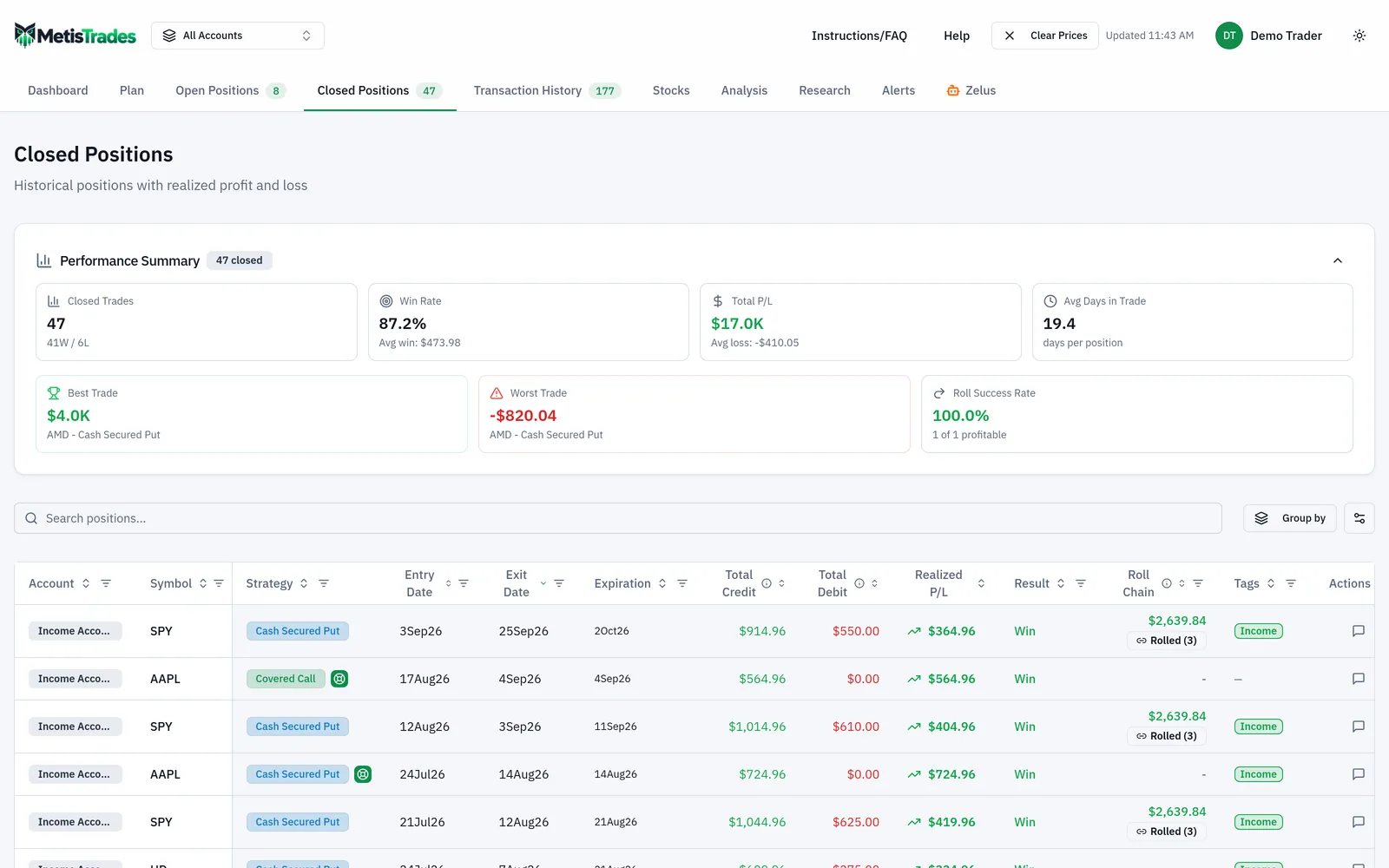
Closed Positions uses the displayed strategy in the same way and offers the same correction and revert flow, so a label you need to fix after a trade is finished is still fixable there.
Common mistakes
- Expecting to pick any strategy from a list. The dialog converts Short Call to Covered Call and Long Put to Protective Put, and nothing else — for other wrong labels, fix the underlying data instead.
- Using Reclassify to fix badly grouped legs. Legs grouped together can match a spread, straddle, strangle, calendar or diagonal pattern you never traded; use the position table's split control, then let the app classify the separate legs again.
- Thinking an override creates shares. It does not create stock, repair cost basis or change assignment records — import the missing purchase or transfer if the share history is genuinely incomplete.
- Assuming every contract is 100 shares. Mini options use 10; check the multiplier before you compute coverage or premium dollars.
- Reading the name as a statement of intent or risk. Strategy names describe the reconstructed position shape, not your intent, risk tolerance or broker approval level — your own notes have to carry that.
- Treating an Unknown label as a bug. It means the opening-leg pattern did not match a supported automatic strategy, often because legs, quantities, strikes or expirations are missing from the import; check the transactions first.
- Ignoring the R badge. It marks a displayed strategy that you overrode rather than one the app inferred, so check the Revert tab's was badge before concluding the classifier got something right or wrong.
Related guides and help pages
Related guides
- Covered Calls Explained: Premium, Capped Upside and Adjusted Cost
- Cash-Secured Puts Explained: Collateral, Effective Price and the Wheel
- Vertical spreads: defined-risk option trades
- Iron Condors, Straddles and Other Multi-Leg Positions
- Calls and Puts: What an Option Contract Actually Is
- Premium, Credits and Debits: How Option P/L Is Counted