Vertical spreads: defined-risk option trades
A vertical spread pairs a bought and a sold option of the same type and expiration. Learn how width, net credit or debit and contract count set your maximum profit, maximum loss and breakeven, then where those figures appear in MetisTrades.
What it is and why it matters
A vertical spread is two options of the same type (both calls or both puts) and the same expiration, at different strikes, with one bought and one sold. The name comes from the way an option chain is printed: strikes run down the page, expirations across it, so two strikes in the same expiration column sit vertically above one another.
Three terms do most of the work here. A strike is the fixed price at which the contract can be exercised. A leg is one option part of the position, with its own side, quantity, strike, expiration and entry price. Contract size is the number of underlying units one contract represents — usually 100 shares for a standard equity option, 10 for a mini option, and a broker-supplied multiplier for futures options.
Spreads come in two cash-flow shapes. A credit spread collects more premium from the short leg than it pays for the long leg, so money arrives when you open it. A debit spread pays more for the long leg than it collects on the short, so money leaves. MetisTrades names the four combinations Put Credit Spread, Put Debit Spread, Call Credit Spread and Call Debit Spread.
The reason to care is the word defined. A bare short option has an open-ended loss; add a further-out long option of the same type and expiration and the loss stops at the distance between the strikes. That distance is the width, and width is the single number that turns an uncapped obligation into a known worst case. Every other figure you need — maximum profit, maximum loss, breakeven — falls out of the width, the net price you paid or received, and how many contracts you traded. You can work all of it out on paper before you place the order, and you should, because the maximum loss is the number you have to be willing to lose.
Both legs of a spread are placed together and behave as one trade, so both should be tracked as one position rather than as two unrelated lines in a records sheet. That is the second half of this guide.
Work it out by hand
We will price two spreads on a fictional stock, XYZ. Quote everything per share first, then scale to the position by multiplying by the contract size (100 here) and the number of contracts. All figures are at expiration and before fees.
The first is a put credit spread: sell the 50 put, buy the 45 put, one contract, taking in a net credit of 1.25 per share. The second is a call debit spread: buy the 55 call, sell the 60 call, two contracts, paying a net debit of 1.80 per share. In the table, a positive net price is a credit and a negative net price is a debit.
The spreadsheet below already contains both rows and the formulas that compute width, maximum profit, maximum loss and breakeven, so you can change a strike or a price and watch the result move.
Download the template: Vertical spread calculator (.xlsx). It opens in Excel, and in Google Sheets via File → Import. The worked example from this guide is already filled in, and the formulas carry down into the blank rows.
| Spread | Type | Short strike | Long strike | Contracts | Net price / share | Width | Max profit | Max loss | Breakeven |
|---|---|---|---|---|---|---|---|---|---|
| XYZ 50/45 put credit | Put | 50 | 45 | 1 | 1.25 | 5 | 125 | -375 | 48.75 |
| XYZ 55/60 call debit | Call | 60 | 55 | 2 | -1.80 | 5 | 640 | -360 | 56.80 |
| Combined | 765 | -735 |
Step 1: the width
Width is the absolute distance between the two strikes, in dollars per share. For the put spread, 50 − 45 = 5. For the call spread, 60 − 55 = 5. Both are five-point spreads, which is why they look comparable even though one collects money and the other spends it.
Step 2: the put credit spread
You received 1.25 per share. The best outcome is that XYZ finishes at or above 50 at expiration: both puts expire with no intrinsic value and you keep the whole credit. Maximum profit is therefore the credit itself, scaled: 1.25 × 100 × 1 = $125.
The worst outcome is XYZ at or below 45. The short 50 put is 5 points in the money against you, the long 45 put is worth nothing extra below that, so the spread settles at its full width of 5. You pay 5 and keep the 1.25 you already collected: 5 − 1.25 = 3.75 per share, or 3.75 × 100 × 1 = −$375.
Notice the check: 125 + 375 = 500, which is the width (5) times 100 times one contract. In a vertical, maximum profit and maximum loss always add up to the width in dollars. If someone quotes you a credit spread where they do not, one of the numbers is wrong.
Breakeven is the price where the short put's intrinsic value exactly equals the credit you kept: short strike − credit = 50 − 1.25 = 48.75. Above 48.75 at expiration you are ahead; below it you are behind; at 45 and lower you are at the full −$375.
One more ratio is worth computing: credit divided by width, 1.25 ÷ 5 = 25%. That tells you how much of the spread's total span you were paid to carry.
Step 3: the call debit spread
Here you paid 1.80 per share, across two contracts. The money is spent up front, so the maximum loss is simply what you paid: 1.80 × 100 × 2 = −$360. That happens if XYZ finishes at or below 55, where both calls expire with no intrinsic value.
The best outcome is XYZ at or above 60. The long 55 call is worth 5, the short 60 call caps anything beyond that, so the spread settles at the width of 5. Subtract what you paid: 5 − 1.80 = 3.20 per share, then 3.20 × 100 × 2 = $640.
Again the check holds: 640 + 360 = 1,000, which is width 5 × 100 × 2 contracts.
Breakeven for a debit call spread is the long strike plus the debit: 55 + 1.80 = 56.80. XYZ has to clear 56.80 at expiration for the position to be worth more than it cost. That is 1.80 of required movement above the strike you bought — the premium you paid is the hurdle.
Step 4: combine the two
Because each spread's worst case is bounded, you can add them. Combined maximum profit is 125 + 640 = $765. Combined maximum loss is −375 + −360 = −$735.
Read that combined loss carefully. It is the sum of two independent worst cases: XYZ below 45 and below 55 at the same expiration. Since those overlap, both can indeed happen together, so −$735 is a real scenario, not an impossible one. Where two spreads sit on opposite sides and cannot both lose fully, adding worst cases overstates the risk. Always ask whether the two worst cases can occur in the same world.
What changes the outcome
Change one input at a time in the worked example and watch which numbers move.
Width
Widen the put spread from 50/45 to 50/40 and keep the 1.25 credit. Width becomes 10. Maximum profit is unchanged at $125, but maximum loss becomes (10 − 1.25) × 100 = −$875, and breakeven stays at 48.75. Width is the lever on risk, not on reward: a wider credit spread risks more for roughly the same kind of credit.
Net price
Get 1.50 instead of 1.25 on the put spread. Maximum profit rises to $150, maximum loss falls to (5 − 1.50) × 100 = −$350, and breakeven drops to 50 − 1.50 = 48.50. Every cent of extra credit improves all three at once. On the debit side, paying 2.20 instead of 1.80 for the call spread cuts maximum profit to (5 − 2.20) × 100 × 2 = $560, raises maximum loss to −$440 and pushes breakeven up to 57.20.
Contracts
Take the put spread to three contracts at the same 1.25. Maximum profit becomes $375 and maximum loss −$1,125. Breakeven does not move: 48.75 regardless of size. Size scales dollars, never prices.
Contract size
Every dollar figure above assumes 100 shares per contract. A mini option represents 10, and a futures option uses a broker-supplied multiplier. Run the put spread at a multiplier of 10 and maximum profit is $12.50, maximum loss −$37.50. Check the multiplier before you trust the dollars.
Time and volatility
Neither appears in the table, and that is the point: at expiration an option is worth its intrinsic value only, so time and implied volatility drop out. They dominate before then. The 50/45 put spread you sold for 1.25 might be bid at 0.90 a week later on no price move at all, because extrinsic value — the part of an option's price above intrinsic value — has decayed. That changes what you can close for today; it does not change the $125 / −$375 / 48.75 structure at expiration.
Fees
Fees are charged per contract, and a spread has two legs. At $0.65 per contract, the one-contract put spread costs $1.30 to open: the realistic best case is $125 − $1.30 = $123.70. The two-contract call spread involves four contract-legs, or $2.60, taking $640 down to $637.40. Closing the position doubles those figures. Small on one trade; not small over a hundred.
Assignment
Defined risk is not the same as no surprises. If XYZ trades below 50 near expiration, the short 50 put can be assigned: assignment means the seller must fulfil the contract, and a short put assignment normally buys shares at the strike. You would own 100 shares at 50 while still holding the long 45 put. The maximum loss arithmetic still holds, but the position has turned into stock plus a put and needs cash or margin to carry.
Where you see it in MetisTrades
Two screens show the same numbers you just computed: one for a spread you are considering, one for a spread you already hold.
Position Analyzer
The Position Analyzer is the strategy workspace under Research, with a public version at the /analyzer route that works without signup. Enter a ticker in Symbol and select Load, then use Add leg twice — Option leg, with Side, Type, Expiration, Strike, Quantity, Price (per share) and IV (%) — to build the 50/45 put credit spread. Quantity means contracts, premiums are entered per share, and the 100-share multiplier is applied to option P/L, exactly as you did on paper. The Price choice controls which chain price is used: Mid is the bid/ask midpoint, Natural is the ask for a long leg and the bid for a short leg. Natural is the default and is the more conservative of the two.
In the screenshot below, look at the Payoff at expiration block beside the diagram. It lists Net debit/credit, Breakevens, Max profit, Max loss and, for a capped-loss credit position, Credit / width — the same five quantities as the table, including the 25% ratio. On the chart itself, the solid curve is the payoff at expiration, the dashed curve is today's theoretical value, Spot marks the latest available underlying price and BE marks the expiration breakevens.
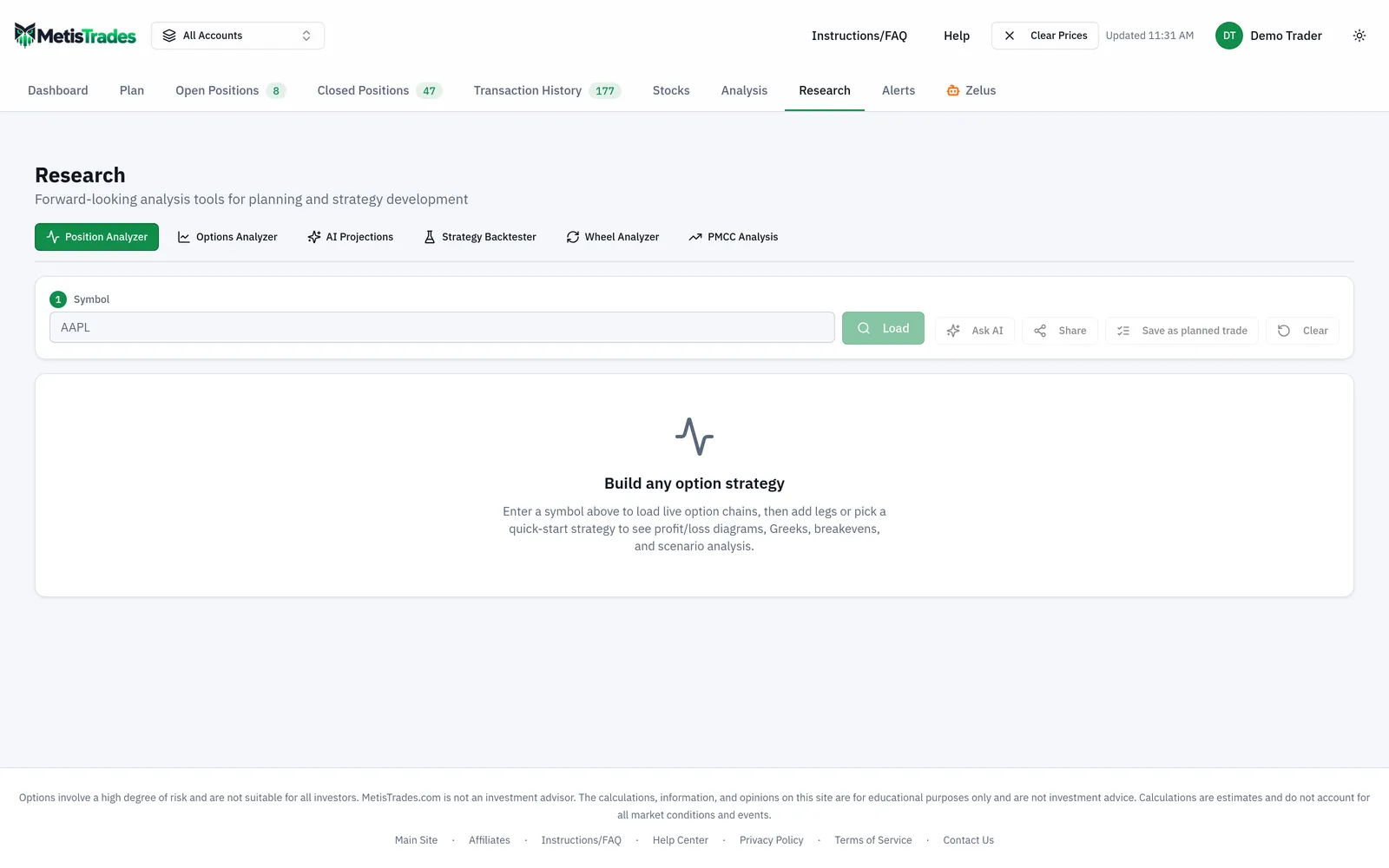
Move Days forward and the dashed curve shifts while the solid one does not, which is the time-and-volatility point from the previous section drawn rather than described. Probability of profit, Expected value, Tail risk (avg worst 5%), non-Delta Greeks and Auto-optimize strikes require Pro; the builder, the P/L chart, the heatmap, the expiration payoff facts, Delta and sharing are available on the public page.
Open Positions
Once the spread is filled and imported, MetisTrades classifies the opening legs by option type, direction, strike, expiration and quantity, and names the result. Two same-type, same-expiration legs at different strikes with one bought and one sold produce Put Credit Spread, Put Debit Spread, Call Credit Spread or Call Debit Spread.
In the next screenshot, look at the Strategy column and at the way both legs appear as one position rather than two separate rows, and at the Analyze column.
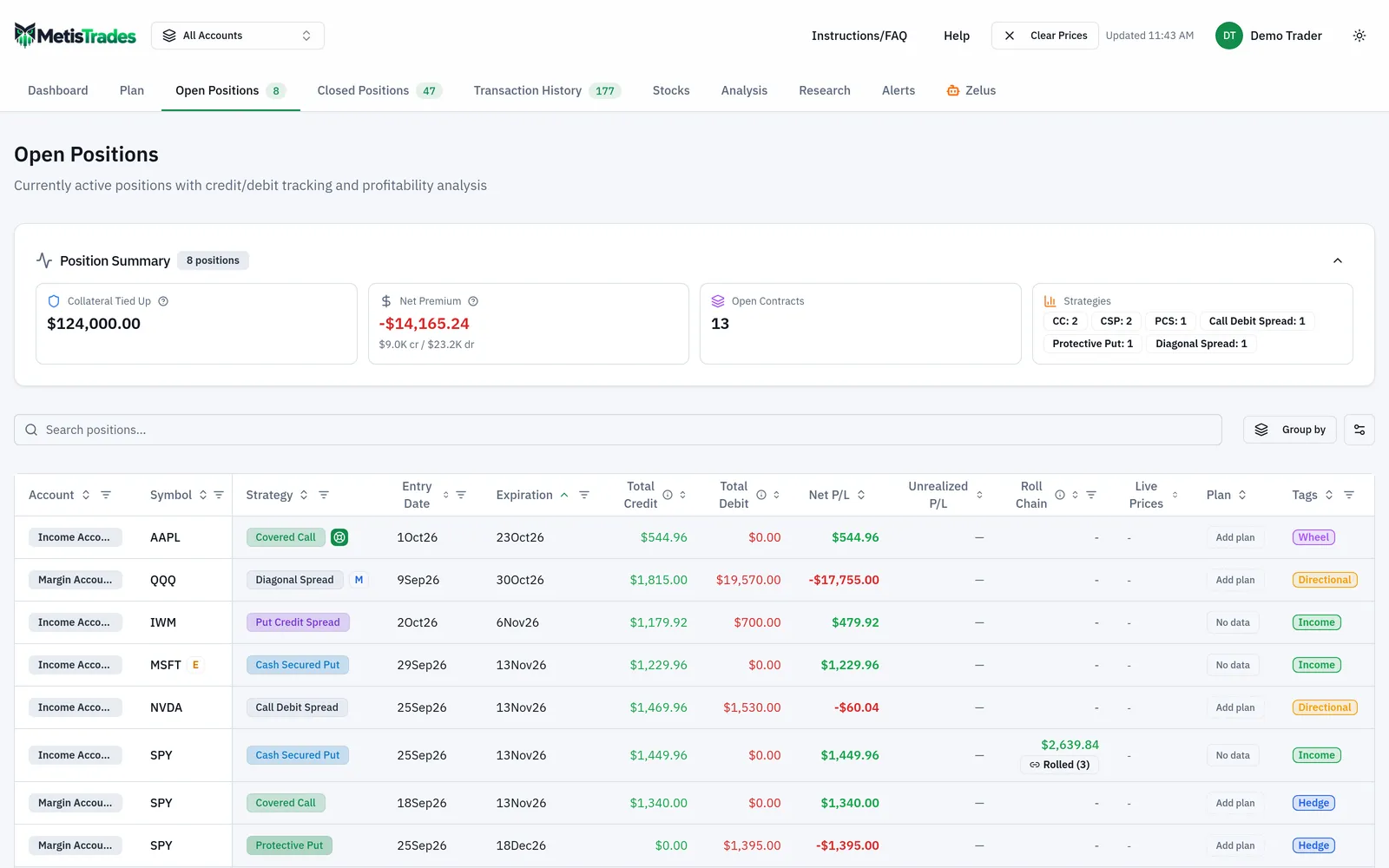
From the Analyze column, Open in Position Analyzer opens a new tab with the position's open option legs already filled in, so you can re-check the payoff on a position you hold without retyping strikes. Open Positions and Closed Positions are Pro surfaces.
Two housekeeping notes. If unrelated legs were grouped together and the combined shape was read as a spread you did not intend, the fix is the position table's split control, not Reclassify — the reclassification dialog only converts Short Call to Covered Call and Long Put to Protective Put. And quotes are delayed: a displayed underlying price, option mark, bid, ask or IV is the latest available value, not a guaranteed executable price, and open-position calculations that use market prices may differ from an executable price.
Common mistakes
- Treating the credit as the risk. The 50/45 spread pays $125 and risks $375. Fix: compute width minus credit, times contract size, times contracts, before you place the order.
- Putting breakeven halfway between the strikes. Breakeven is 48.75 for the credit put and 56.80 for the debit call, not 47.50. Fix: short strike minus credit for a credit spread; long strike plus debit for a debit spread.
- Assuming every contract is 100 shares. Mini options use 10 and futures options use a broker-supplied multiplier. Fix: confirm the multiplier before scaling per-share figures into dollars.
- Forgetting the second leg's fees. One two-leg spread is two contract charges to open and two more to close, and two contracts doubles that again. Fix: subtract round-trip fees from maximum profit when you judge the trade.
- Believing defined risk rules out assignment. A short leg in the money can be assigned and leave you holding shares. Fix: plan for the short strike being breached, including the cash or margin that assignment would need.
- Adding worst cases that cannot both occur. Our two spreads can both lose fully, so −$735 is real; two spreads on opposite sides could not. Fix: ask whether one underlying price produces both worst cases.
- Using Reclassify to repair wrongly grouped legs. It only converts Short Call to Covered Call and Long Put to Protective Put. Fix: split the incorrectly combined position and let the app classify the separate legs again.
Related guides and help pages
Related guides
- Calls and Puts: What an Option Contract Actually Is
- Reading a payoff diagram: profit and loss at expiration
- The Greeks in practice: delta, theta, vega and gamma
- Covered Calls Explained: Premium, Capped Upside and Adjusted Cost
- Cash-Secured Puts Explained: Collateral, Effective Price and the Wheel
- Iron Condors, Straddles and Other Multi-Leg Positions